

This is the third in a series of interviews with governors navigating their state’s responses to the coronavirus crisis. Ohio Gov. Mike DeWine and Pennsylvania Gov. Tom Wolf were the first two.
Tate Reeves, the 65th governor of Mississippi, describes the moment — the day after a savage and deadly storm that left a tangle of power lines, trees, overturned vehicles, flattened homes, barns, and death — as the kind that brings you to your knees.
He was in Jefferson Davis County the day after the Easter tornado when a woman approached him with a mask covering her nose and mouth and devastation in her eyes.
“She told me the tornado had come through and had torn down the church where her husband was the pastor, and that had been the day before,” he says. “And with tears in her eyes, she said to me that, ‘It’s only been 13 days since I got out of the hospital having recovered from the coronavirus.'”
“I so want to give you a big old hug right now and tell you that everything’s going to be okay,” he says he told her. “I told her we are going to recover from this. As difficult as this challenge has been.”
The 100 days or so since Reeves was sworn in as governor have been nothing short of a baptism by fire.
“We’ve had an interesting run,” he tells me. “Yesterday, the president approved an emergency declaration for us on some storms that occurred in early February. It was the sixth federally declared emergency during my less than 100 days in office. To put that in perspective, we now have 12 total outstanding emergency declarations since Hurricane Katrina, and six of the 12 have been signed in the last three months,” Reeves explains.
After the interview, Reeves logs on to do his Facebook Live-streamed news conference, where he will announce that on Monday, April 27, Mississippi will begin its slow dance of reopening. Before the conference is over, nearly 220,000 people will view it, 4,000 will comment, and nearly 2,000 will share it.
For one hour and three minutes, Reeves lays out the details of his replacement of the state’s “shelter-In-place” order with a new “Safer-At-Home” order and takes dozens of questions and follow up questions from the press.
The new order will remain in effect until May 11; the details are complicated and contain important changes for everyone from businesses to those who work for them to residents.
His delivery on Facebook Live is part of what he says is his commitment to deliver news content continuously on multiple platforms to inform his constituents, something he began as a candidate as a way to communicate with voters that he has incorporated into how he structures his day governing.
But it is his Facebook Live news conferences that are reaching the most people.
Since the middle of March, Reeves has done a total of 36 Facebook Live videos; as of Friday afternoon, 21 of them have been press briefings, 5 were Bible studies he has done with his family, as well as two FB Live Q&A’s with questions submitted by Mississippians and followers.
The total number of minutes viewed is over 15 million, with engagement by over 460,000 people.
Once you decide part of governing is communicating with people, directly, you find ways to do it. For Reeves, Facebook Live has been his method for communicating with his constituents.
“We have been blown away at the growth numbers that we have seen in our social media platforms and on Facebook Live videos. We are getting over a million views, which is more views than we had total voters in the 2019 election,” he says.
“The next phase of our conversation,” Reeves says, “is how do we keep this going post-COVID-19, assuming there is a post-COVID-19? When I came in to the governor’s mansion there was basically no technology in here at all, so we’ve had to make a makeshift technology group to ensure that not only are we communicating with our constituents on Facebook Live, we’re also, of course, communicating with the Coronavirus task force and with the president and the vice president. And also with other governors,” he explained.
The Zoom and FB Live press conferences have also had a positive impact for the state’s press corps, opening up the governor’s daily press briefing to reporters across the entire state rather than just the ones located at the state capital.
“For instance, a guy by the name of Dave Elliott, who is a real reporter down the Mississippi Gulf Coast that works for a TV station,” says Reeves. “He calls in every day, and he asks questions every single day. If we had not had the Zoom session, he would ask me a question once every three months. Now, he’s getting to ask three questions every day. Now, TV stations in remote markets and the journalists in the remote markets have now made the Capitol Press 4 times larger now because of these technology advances and because we were allowing Zoom to do it.”
In the interview, Reeves shares his thoughts on the state’s economic and health challenges, working with the governors of his neighboring states, his views on regional rollouts, and how faith and family have kept him grounded in this crisis.
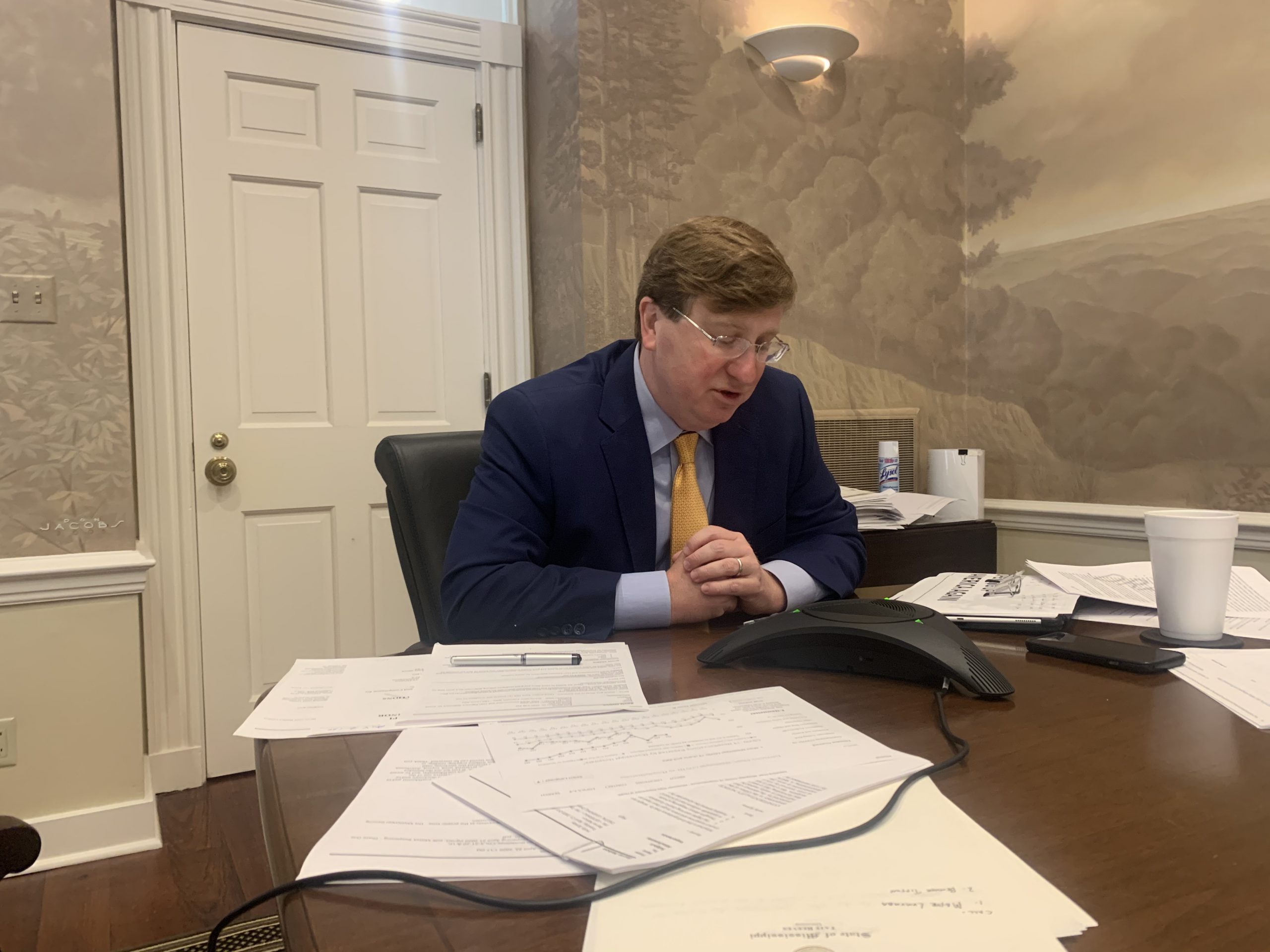
Washington Examiner: Aside from the virus, has using these different platforms helped you have the conversation with your constituents about other things, like the Easter Tornado storm system?
Tate Reeves: “Well, no question. And the advantage to it is I can go directly to the people and warn them of the unique challenges from a weather standpoint that are happening. And so we’ve been able to go on Facebook Live or use our social media platforms to reach hundreds of thousands of Mississippians and just tell them, ‘Hey, if you live between Jackson and Hattiesburg,’ for instance, ‘you need to be very weather aware today, or very weather aware tomorrow. The conditions are very favorable for tornadic activity.’
“We’ve had an interesting run. Yesterday, the president approved an emergency declaration for us on some storms that occurred in early February. It was the sixth federally declared emergency during my less than 100 days in office. To put that in perspective, we now have 12 total outstanding since Hurricane Katrina, and six of the 12 have been signed in the last three months.
“We’ve had historic flooding, historic tornadoes, and now, obviously, historic virus. It’s been crazy.”
Washington Examiner: What’s been your biggest challenge, and what’s happening going forward for the state? Or challenges?
Tate Reeves: “I think that the biggest challenge for all of us is the initial recognition that we have a short-term public health crisis on our hands. But at the same time, we have, at a minimum, a short-term economic crisis. And if we don’t act decisively, we’re going to have a long-term economic crisis in our state, and, quite frankly, in our country.
“And so for those individuals that are not looking at this situation from that prism, I would argue that they are making a major mistake. Because if you only focus on the immediate public health dangers, we’re going to create more economic dangers in the long term.
“And so from a challenge standpoint, if you start from that prism, then the challenge becomes how do we weigh the short-term public health analysis with the long-term economic analysis?
“So, for instance, Mississippi, five weeks ago, we had less than 1,000 unemployment insurance claims. Over the last three weeks, those numbers have been 32,000, 46,000, and back down to 35,000 yesterday. And so, we’ve had 120,000 just in the last three weeks of unemployment insurance claims, which is more than the combined number of lanes in the two years prior to three weeks ago.
“And so, it is mind-boggling to me the severity of the economic challenges that we face. Because of that, we have to be willing to be smart but to recognize that we have to continue to find ways to open up areas of our economy as it becomes safe to do. We will announce later today that we are going to allow for our shelter-in-place order, which has been in effect now or will be on Monday for 21 days. We’re going to allow it to lapse.
“We’re going to move toward a ‘safer-at-home’ order, which allowed them more businesses to reopen. But we’re also doing it in a way that’s smart. We’re not going to open every business. If there’s close, personal interpersonal contact, then we’re not quite ready to let those get open. And so, we’re trying to, again, be smart. And rather than taking a sledgehammer in either direction, we’re trying to be surgical in nature and make sure that we’re doing the right thing for as many Mississippians as we can.”
Washington Examiner: When you do your rollout, is it going to be the whole state, or are you doing it regionally or county by county?
Tate Reeves: “That is a great question and one that has had a great deal of debate in this conference room over the last four or five days. And so, here’s how I would answer that. So, we’re going to do a rollout on a county by county basis. We are also going to do a rollout on a region by region basis. But the end result of that is going to be that we are going to open up statewide and here’s why. In working with our state health officials, we don’t believe that there is any one county that justifies continued shelter-in-place orders.
“And said differently, we don’t have any one county that has just significant outbreaks that are not, at least relatively speaking, manageable. So we looked at it in every single county, we looked at all 82 counties, we looked at every single region. And the ultimate decision is going to be that we’re going to allow what is a phased-in approach to start occurring in all 82 counties.”
Washington Examiner: Have you worked with any of your bordering states, have you had any conversations with them before you’re going to do this rollout?
Tate Reeves: “We have had multiple conversations. Primarily in the heat of the crisis that was occurring in Louisiana, I had multiple conversations with Governor Edwards. I’ve been very supportive, by the way, with the federal government, with Governor Edward’s request because he needed help in New Orleans. And to President Trump’s credit, the federal government has been very active in the state of Louisiana. And I was very supportive of that, and I still support it, I think it was the right thing to do.”
“We’ve had multiple conversations with our friends in Tennessee and Alabama and Florida and Georgia and South Carolina, as well. You know, we are all conservative states that think like-minded. We don’t all have exactly the same rollout plans, but we have had many conversations surrounding what that may look like in the various states. We’re not going to have a regional approach because every state’s different. I think that you’ll find that we are like-minded, and we have had many conversations around what it looks like and where we find ourselves in the cycle.”
Washington Examiner: How has your family and faith guided you through this?
Tate Reeves: “So, my grandmother just had a birthday two or three weeks ago, and she has not really come out of her house since the beginning of this. She turned 88, I believe. And so, I haven’t seen her. My mom is also in the vulnerable category just in terms of the fact that she is retired, and her husband has had cancer. And so, I’ve been very adamant to them that they need to stay home and not come out, and that we would make sure that we got groceries or whatever delivered to them because they’re in the more high vulnerable category.
“It’s been interesting. I have had the opportunity to eat a lot of meals with my kids because they are staying at home, and I am ‘officing’ basically out of the place where we’re living, and so, that has been good.
“But look, the best thing for me has been the number of people on our social media platforms and just the number of people on my cellphone that are texting me and saying, ‘Hey, I just want you to know we’re praying for you. I just want you to know we’re praying for you.’
“And that’s one of the things that I will tell you in these times, I believe in the power of prayer. And I absolutely can feel it, that people all over this state, quite frankly, all over this country, are praying for us to make the right decisions. And that is a powerful, powerful tool and one that I don’t take lightly.”
Washington Examiner: Do you foresee yourself, once this is over, getting in your car and just driving around on the back roads to see the impact that it’s had on your state?
Tate Reeves: “I cannot wait to get out and about and see the people of Mississippi. Now, I will tell you, because of the natural disasters we have been out some. I have flown in helicopters to look at the damage. And I’ll tell you this, the very first helicopter ride that I took during this virus was with our Mississippi National Guard, we’ve deployed them to help with the virus. We flew down to the Mississippi Gulf Coast and into Hattiesburg to look at some potential alternative care sites. That was when we thought we may have to surge capacity for hospital beds, and we laid the groundwork to make that happen.
“It was absolutely difficult for me to be flying at 1,000 feet, looking at the beautiful landscape across Mississippi. You could not tell at all from that vantage point that the virus is out there, but yet you knew that it was out in every single community in our state. And it was just really a powerful opportunity for me to really think how much this is going to affect individual Mississippians.”
Disclosure: Tate Reeves is a client of Brad Todd, who co-authored The Great Revolt with Salena Zito.
