

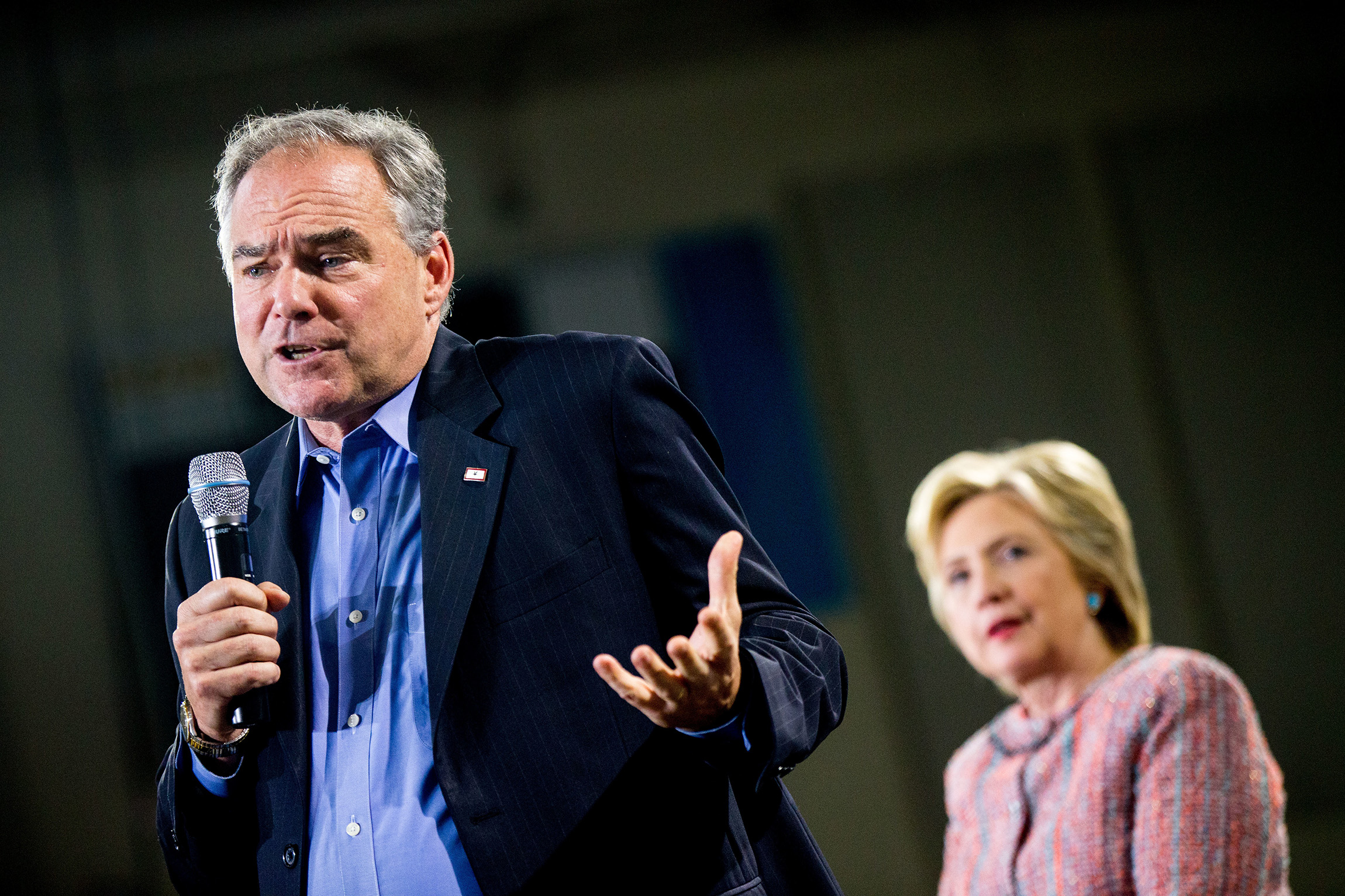
With Donald Trump as her opponent, Hillary Clinton decided her task was mostly to not mess up — to play it safe. That’s why she picked Tim Kaine as her running mate.
Recommended Stories



When Clinton and her team considered their options for a running mate, it was always a question of the competing dangers the campaign faced. Which of them would win out?
In one scenario, the greater danger was a slackening of left-wing progressive turnout. If the Left failed to show up and vote for her in sufficient numbers in an election that is shaping up to be a low-turnout, base-driven affair, she might face the possibility of losing not only swing states, but also a few more reliably Democratic states where Trump plans to compete, such as Pennsylvania. This consideration might have recommended someone like Sen. Elizabeth Warren, D-Mass.
In another scenario, Clinton may have made her pick with an eye to Hispanic turnout. If victory in Colorado, Nevada or Florida seemed in doubt — or on the positive side, if Arizona seemed ripe for the taking — then a Hispanic running mate might have been the natural choice, such as Julian Castro, Obama’s secretary of Housing and Urban Development.
These options had their own innate weaknesses. Castro, for example, is a bit of a lightweight — a professional rising star whose role as mayor of San Antonio was purely ceremonial, and who has ethics problems to boot. Warren was always a risky option for many reasons, not the least of which is that the progressive populist might upstage the former first lady.
Had Clinton faced a stronger general election opponent, she may have had to take a risk. Facing instead a political novice with negatives even higher than her own, and with a fraction of the money and campaign infrastructure, Clinton was free to play it safe.
Kaine is known for being warm, intelligent and serious. He has considerably more government experience than Clinton herself, having served as mayor of Richmond, lieutenant governor, governor and senator. Also, unlike Castro, Kaine speaks fluent Spanish. Despite his virtues, he’s also not so flashy and likable as to upstage Clinton completely. This might have been a concern had she gone with someone like Sen. Cory Booker, D-N.J.
In choosing Kaine, Clinton may not have been mostly thinking about this fall. She was, perhaps, choosing someone for the job of vice president rather than the role of running mate — someone she can work with for four or eight years.
One potential drawback to Kaine is that he’s a bit too centrist for the Democratic Left. He has at least given lip-service to being pro-life. More recently, he elicited the ire of the Left when he joined a number of other Democratic senators in signing a letter calling for looser regulation of smaller, regional banks.
Another drawback: like his successor as Virginia’s governor (who until recently faced a prison sentence) Kaine received an obscene amount in gifts while serving in statewide office — $160,000 worth, to be precise, including a Caribbean vacation and clothing. That sum may not seem like much in Clinton terms, but it feeds into public doubts about Clinton’s personal profiteering from public service.
Still, as he has shown in recent appearances with Clinton, Kaine is very strong on the stump. He has a long political record to prove this, given that he was strong enough to end the career of a retail politician as formidable as former Sen. George Allen, R-Va., whose 2012 comeback attempt he stopped cold.
There is one other consideration — Kaine has a stellar resume to one day run for president. Clinton’s decision is best seen not as a matter for this fall, or even for the next four or eight years. With the Republican Party in its most perilous state in a generation, Clinton may be thinking about the next 12 or 16 years.
Timothy P. Carney, The Washington Examiner’s senior political columnist, can be contacted at [email protected]. His column appears Tuesday and Thursday nights on washingtonexaminer.com.
