

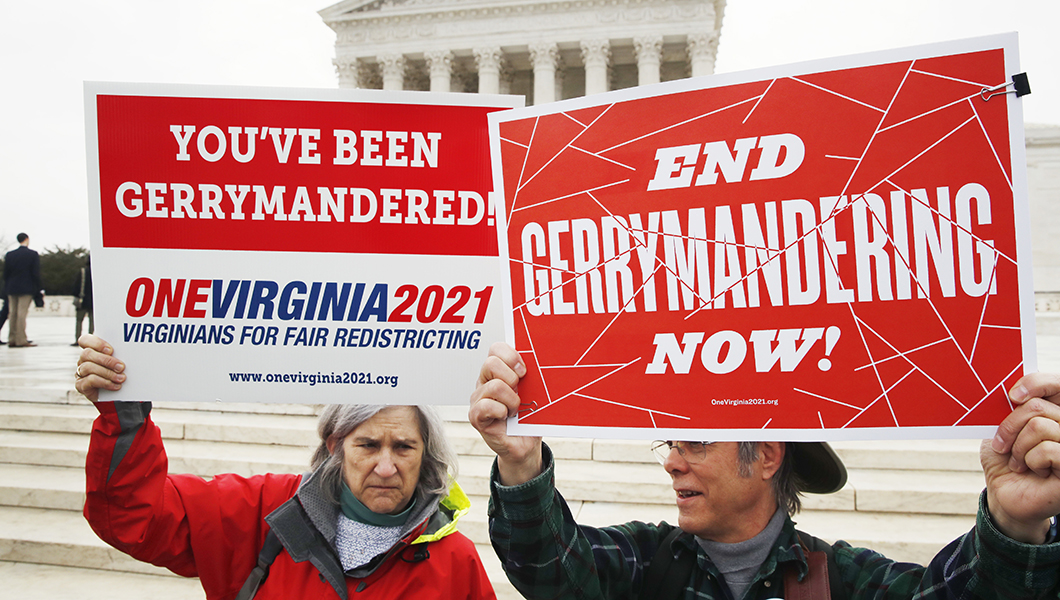
On March 3, the House of Representatives passed House Resolution 1, which in part calls for an end to partisan gerrymandering.
While the wisdom of much of the bill’s substance may be debatable, Republicans should embrace an end not only to partisan gerrymandering but to racial gerrymandering as well. The fences and razor wire that surround the U.S. Capitol symbolize the political polarization gripping Washington, D.C. Pundits debate whether it has ever been this bad.
Recommended Stories



It has.
Prior to the Civil War, there was the 1804 Aaron Burr-Alexander Hamilton duel which capped off the political rivalry that had erupted after Hamilton helped deny Burr the presidency when he and Thomas Jefferson tied in the Electoral College in the 1800 election. Andrew Jackson, in office between 1829 and 1837, was a particularly polarizing president, perhaps even more so than Donald Trump. Then, there was the Brooks-Sumner affair in which a South Carolina representative bludgeoned a Massachusetts senator inside the Senate chamber after a vitriolic debate about slavery.
The media environment certainly contributes to the problem. Watergate changed journalism as it transformed Bob Woodward and Carl Bernstein into celebrities. Prior to President Richard Nixon’s resignation, journalists got their start on local beats, often without college degrees, just reporting the basic who, what, where, when, and why.
After Watergate, elite Ivy League graduates and others flooded into journalism schools seeking to be the next Woodward and Bernstein. Quickly, the line between reporting and agenda advocacy blurred, and distrust of the traditional media along with it. Broadcast media also changed. Nixon installed three televisions in the Oval Office so that he and his aides could monitor the three national news programs simultaneously. Throughout the 1970s and even into the 1980s, television stations would play the national anthem at around 1 a.m. and then sign off until 6 a.m. Then cable news and the 24-hour news cycle changed the dynamic as media companies had to fill the space. The rise of social media has catalyzed divisions further.
A broader problem lies with increasing partisan gerrymandering. While party strategists may in the short-term relish the advantage safe-seats give their party, in the long term, allowing like-minded voters to dominate a district creates a class of highly partisan elected officials. These are politicians who not only have little incentive to reach across the aisle but may actually jeopardize their seats if partisan constituents find them insufficiently loyal. A comparison of ideological orthodoxy with gerrymandered districts reinforces that gerrymandering promotes extremism from both the Left and the Right. In contrast, more competitive districts tend to incentivize candidates to reach across party lines.
In a 2010 article, Matthew Frankel, at the time a federal executive fellow at the Brookings Institution, found that the 50 most liberal members of Congress received on average 79% of the vote in their districts, while the 100 most moderate members on average won with 62%. A second-order effect of partisan gerrymandering is that safe districts allow state and national party organizations to transform competitive districts into “battlegrounds,” which cultivate partisan division in a race that might otherwise focus on more local issues.
Some academics question the importance of gerrymandering in increasingly American polarization. Events, commonsense, and centrist politicians from both parties disagree. Republicans and Democrats in Congress privately say the one consistent finding they receive from home district polling is that constituents want them to reach across the aisle more. Social issue warfare, political posturing, and topics that might inspire Twitter warriors may be popular in gerrymandered districts, but more heterogeneous districts are more interested in growing the economy.
As Center for American Progress fellows Brian Katulis and John Halpin have noted, the problem extends to foreign policy. In this domain, elites (albeit not just elected representatives) tend to focus on issues that divide people rather than those which unite them.
Yes, Republicans may oppose House Resolution 1 and may have good reasons to do so. But maintaining partisan gerrymandering is not one of them. If America is to heal, politicians must be prepared to argue ideas on their merits rather than bypass debate by fixing the playing field. America is at its best when Democrats and Republicans must convince those across the aisle that they have the best ideas. Stacking districts prevents that.
Michael Rubin (@Mrubin1971) is a contributor to the Washington Examiner’s Beltway Confidential blog. He is a resident scholar at the American Enterprise Institute and a former Pentagon official.
