

YOUNGSTOWN, Ohio — Sometimes even legends can’t stop hurricanes.
“And this hurricane’s still blowing,” said Jim Tressel.
Twice a week, Tressel, the president of Youngstown State University and former longtime winning football coach of The Ohio State, is on a call with 14 of the state schools of higher education in Ohio. As is the case every day, the only thing that remains certain is uncertainty.
“We meet every Monday and every Thursday, and we talk about what ideas are brewing on our campuses,” Tressel said of the exhaustive effort to come up with a plan and to keep the lines of communication open. “Our provosts in the 14 publics meet once a week on the phone. Our chief financial officers meet once a week. Our HR directors meet once a week. Our IT people meet once a week.”
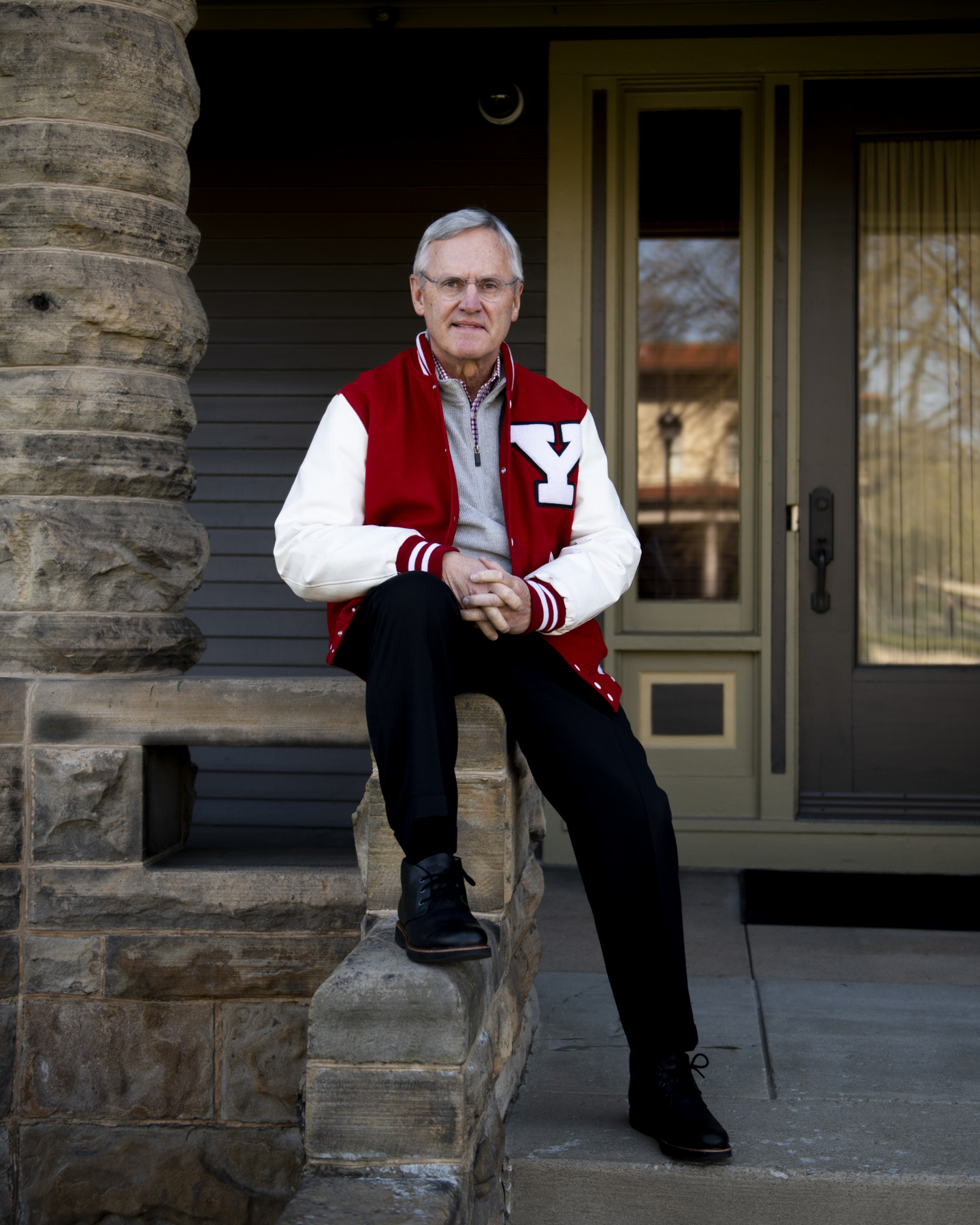
“Between the 14 of us coming up with new ideas and strategies and good communication, we’re trying to plan for everything,” he said. “What do they always say, plan for the worst, but hope for the best?”
The schools include YSU, Ohio State, the University of Cincinnati, Miami (of Ohio), the University of Akron, Kent State, Cleveland State, Northeast Ohio Medical College, Toledo, Bowling Green, Wright State, Ohio University, Central State, and Shawnee State.
“You better have a plan for all of it,” he says in that distinguishable coach’s tone that chilled even the hardiest of linebackers on the field.
“But I will say this, the biggest question, I feel, from our students is that, ‘Hey, are we going to be back here in the fall?’ And that’s the big one.”
“I don’t want our kids to lose that hope, because nearly half of them are first-generation college students.”
Tressel is at his Wick Avenue university home on the campus at YSU. We can photograph him in front of the old majestic Pollock House from a distance and through his window, but we ultimately do the interview on the phone instead of shouting at each other while maintaining “safe distancing.”
He earned his legend card on the football field, first here and then at Ohio State where he finished with an official overall record of 94–22, six Big Ten Conference championships, a 5–4 bowl record, and a record against the archrival Michigan Wolverines that placed him second in OSU history only to Woody Hayes.
He took the helm at YSU in 2014 and has led the transformation of the school from a commuter school in a dying town to a university helping inject promise to the center of the city’s rebirth.
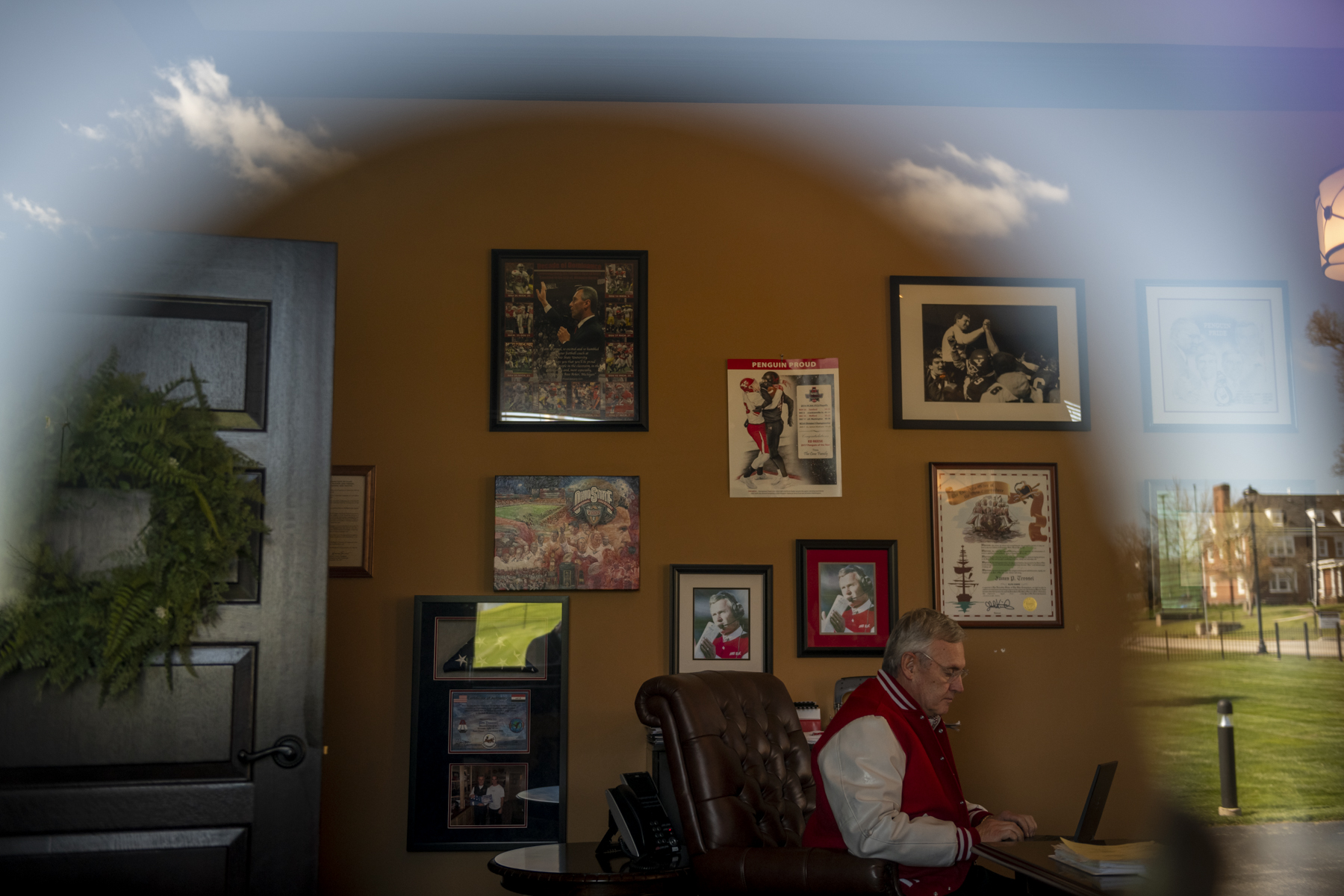
His mark on this city has been as impressive as his discipline on the football field. He has improved the school’s full-time enrollment and its footprint in the city, more than tripled the Honors College enrollments, filled the student residencies to capacity, and added two privately financed student apartment complexes.
Along with that have come coffee shops, bookstores, and new liveliness downtown.
He also restructured the operating budget, which upgraded Standard & Poor’s bond rating to an impressive A+, and the trustees just agreed in late 2019 to extend his contract for another year, through June 2021.
It is what happens here and at other higher institutions across this state and the country between now and June 2021 that has everyone wondering what is next for higher education.
Last week, Urbana University announced it was closing its campus for good at the end of the semester in May, in large part due to the challenges brought on by the coronavirus pandemic as well as years of sluggish enrollment.
The small liberal arts college was part of the vitality of the city of Urbana in Champaign County, Ohio. It isn’t just the students or faculty who are affected, but also the coffee shops, salons, convenience stores, food markets, banks, and restaurants located in the town square.
On Tuesday, Tressel said he rolled out what he calls “Take Charge of our Future,” a five-point plan administered by 50 people, both faculty and students, who will coordinate focus groups to respond to the coronavirus challenge.
“There will be committee creative course offerings, scenarios to a return to YSU, enrollment with both retention and attraction of new students, and an ongoing communications group,” he said.
In our interview, Tressel discussed the complexities of the future for higher education in the near and not too distant future, the possibility of the loss of the college football season, the importance of not allowing students to lose hope, and the strenuous efforts to decide when college life comes back to normal.
Washington Examiner: Let’s start at the beginning. What was your first order to do with the university when this first broke out?
Jim Tressel: Well, it became apparent as things were really heating up that we were going to have to be thinking about teaching remotely. We were on spring break, and so we made the decision early in the spring break week that we were going to extend our spring break another week, which would give our faculty a chance to get equipped to begin their remote instruction.
And what’s interesting is that only 10% of our classes were fully online, and so it was really 90% of our offerings were face-to-face.
Our IT people, our faculty and the communication that had to take place, not just here, but with our study abroad courses that were scattered all over the globe.
We had to reach out to them and recommend we get them home. And then, of course, our people that had residence hall scenarios, we knew we were going to be totally remote. We couldn’t have a big move-out day like you have a move-in day, because that’s contrary to social distancing and so forth. The one thing here in Ohio, our governor was really proactive.
It was a mad scramble, quite honestly, and the biggest thing that we had to figure out was who, from a faculty standpoint, needed some specific tutelage and maybe some equipment, and who, from a student standpoint, needed [what], whether it be Wi-Fi hot spots or laptops or whatever.
So we were doing constant surveying and reaching out to students.
It was interesting, we had a higher percent of our students that had devices than we thought might be the case. We just didn’t know. Because we have about 44% of our students are Pell Grant eligible, which I think is maybe the second-highest in the state, which means their family income is such that they do qualify for those federal funds.
That being the case, we weren’t totally sure what the frequency of the devices would be, just how many, and we were pleased that it was more than we thought, but there were still significant numbers that didn’t have adequate remote learning equipment.
So we spent just over $600,000 in purchasing of equipment and Wi-Fi ability and that type of thing, so that our students could go on WebEx and Zoom and GoToMeeting and all those various places so they could do remote learning.
And really, kudos to the federal government, when they did that CARES Act, the formula they used, once they decided the total amount that would go to small businesses and the total amount that we go to healthcare and the total amount to higher education, the way they broke up the formula for how it would be dispersed to Higher Ed was based upon your percentage of Pell Grant-eligible students.
So that was something that they could quantify, they could make sure it was being done properly, in terms of where some assistance might be needed. And so, we were fortunate that we got a little bit of help.
Within 13 days, we had 2,700-plus courses moved totally remote. We had the faculty equipped, the students equipped, and now it became, how were we going to execute now that we have the equipment to do it. We had the tools to build the house, now we have to go build the house.
Washington Examiner: Let’s talk about the emotional and economic toll this takes on this college town, and maybe college towns across the country. In particular, places like Youngstown, where Youngstown State has been integral in helping Youngstown on this road to recovery. Colleges have an oversized impact on a town’s economy; the coffee shops, apartments, when they’re old enough, bars, restaurants, barbershops, gas stations.
Jim Tressel: Obviously, for this short moment, we all know that there’s going to be impact that hopefully you can overcome. But we’re hoping that it’s short. I think what’s most stressful to local businesses, whether it’s the beautiful new Doubletree downtown, that so often if there’s a Youngstown State event, they have better bed counts and so forth, and all the activities that surround our campus. I think the stress right now, as I listen to small business owners and the people around the town, is that we can do anything for a minute, but boy, I hope we’re back here in the fall.
That’s the emotion.
Washington Examiner: What about the fall?
Jim Tressel: The scenario we’re planning for is, if we come back and start when we normally would, how can we make sure that we have protocols in place that this is the safest environment you could possibly have, because we all know that this isn’t like a storm or hurricane, and it’s here, and it’s gone, and you just rebuild.
And this hurricane’s still blowing. How can we make sure that we can still do all of those fundamental things like social distancing and making sure we have the safety and the sanitation and so forth?
So, scenario one is we start as normal, and we have things in place, and we’re trying to work on some creative curriculum ideas. Now we know we can be remote. Well, we’d rather be face-to-face. Well, let’s do a plan where we’re maybe a little bit of both. What if we have a math class with 30 kids that meets four days a week, maybe we have eight of them in the classroom every meeting and 22 of them remote. And then the next group kind of rolls in, so that everyone gets some face-to-face, and so we keep that social distancing and the lack of crowds, and so forth. That’s a whole committee of its own, how are we going to have creative course offerings. So scenario one is we start when we normally start.
Scenario two is we start after Labor Day. Some people are having that discussion. Scenario three is we start halfway through the semester. Scenario four is we don’t get back here face-to-face for the whole semester, but we start in January. Scenario five is, what are you going to do if the entire year is remote, and how are you going to make sure that we do that extremely well?
You better have a plan for all of it.
But I will say this, the biggest question, I feel, from our students is that, “Hey, are we going to be back here in the fall?” And that’s the big one.
Washington Examiner: What are the top concerns among all of you? Is there anybody concerned that you know, some of the smaller colleges, not yours, but like tiny, little colleges, that they might close forever, or is that not something that’s on the table?
Jim Tressel: I think we’re all very concerned about what does the future look like. I know we’re all modeling for a couple financial realities. One is, will the state be able to have what we call SSI, which is State Subsidy for Instruction? Will it be as good as it’s been in the past? We already had a 20% cut for the last eight weeks of this academic year. They’re saying that you better be modeling for at least a 20% cut in the fall for the whole year. And then, of course, we’re all very concerned about enrollment because enrollment is what drives your revenue.
All of us have different size on-campus populations, and so there are many schools [that] have a significant amount of debt service on residence halls. What I like to say is, I was talking with one of my friends, Joe Cassese, who runs the [Mahoning Valley Restaurant] and I said, “Man, I can’t even imagine what it’s like for you.” I try to go down there and get carryout three times a week just to see if it could be helpful and so forth. But I said, “I can’t even imagine what you restaurants are going through.”
But you know what’s interesting is universities, we are part restaurant, part hotel, and all large-group gathering, which is probably not the three best things to be right now.
I think we are all concerned about what’s the impact going to be, honestly. But nevertheless, you’ve got to just work like crazy. You asked about those small schools. I have a friend who is on a board at a small school, and I was asking him what they were modeling for. And he said, “We’re modeling for anywhere from a 20 to 30 to a 50% drop in enrollment.” And he said, “Now, 50% would be drastic, but you have to plan for the worst.”
There are a lot of folks wondering if we get our students back on campus for the fall and have our residence halls at least pretty full, we probably won’t have them totally full, it will make a big difference.
If we go another full year remote, I think the operating costs of all those residence halls and dining halls and so forth, I think that will be the one, if anyone topples, I think it will be because of that. But it will be interesting.
The other thing that I’ve been saying to our people all along here the last three or four weeks is, if you ever wanted an advertisement for the importance of higher education, you just got it. Because everyone in the world is anxiously awaiting a vaccine, and the only one that’s going to come up with a vaccine is someone who has spent 12 years in K through 12, four years in Higher Ed, probably another five years getting their PhD or medical school, and then some postdoc and then some research.
The heroes in healthcare are all pretty much higher educated folks, whether they’re doctors or pharmacists or nurses or respiratory therapists, or you name it.
Well, that’s going to be interesting, too. I think, like the whole institutional scenarios that you’re preparing for, you hear some people say, “Well, we might not start until late September and play only conference games,” or something like that. And it’s all going to be so fluid and so based upon how does that curve look and is there a resurgence and are we able to develop these antibodies? I think as we’ve been talking institutionally, we’ve come to the conclusion that by mid to late June, we really need to have a feel, are we going to be physically back on campus, so that we can prepare accordingly.
Washington Examiner: What about college football? You coached here, you coached at Ohio State, it is what America does on Saturdays in the fall, whether your team is D-3, or a Rose Bowl contender.
Jim Tressel: I think from a football standpoint, I think that could be even pushed back. I think if they know by the end of July that they might be able to reconvene, you might have to allow for some safety training and so forth and push back your games for a little bit. Who knows? Maybe only allow so many people in the stadium or… I think there’s just so much we don’t even know, and every day we’re learning a little more. Some days, you get some high hopes, and then the next day you’re like, “Oh,” you take a step back. Whatever the guidelines are, whatever we’re allowed to do, we’re going to do that as well as we can.
I think the real magic behind the whole thing is, I think cognitively, we really believe that this adversity will be a real builder for these young people, but we’ve got to get them through it so that they can see where they’ve grown from it. Like the old-fashioned, you have to keep that hope alive.
I don’t want our kids to lose that hope, because nearly half of them are first-generation college students.
They’re the key to, what we talk around this area as, our brain gain. We need to have those people progress. And really, in the workforce of the future, it’s going to be so highly technical that you’re going to need well-educated people to do most every job. A strong back won’t be all you need. And so, we just don’t want to lose that hope for our students because we know they’re going to need certain tools to make it in life. And so, we just can’t let this derail their progress.
The thing about people from Youngstown is that we are emotionally drawn to this area. Even our people that end up leaving the area, when I was the head coach at Ohio State, would be all over the country at alumni meetings and this and that. And I’d see someone from Akron, Ohio, or Dayton or Toledo, it was “nice to meet you,” and that was that.
If someone was from Youngstown, it was like the pride they had in being from here, that even if they didn’t live here, that emotional, that connection was just irrefutable. In fact, my players at Ohio State used to always say, “Coach, what is it with those Youngstown people?”
I said, “Well, you’d have come from there to understand.”
Washington Examiner: How long have you been at YSU now?
Jim Tressel: This is my sixth year. I was going to come three and then go sit on a beach somewhere, and here I am in my sixth year.
