

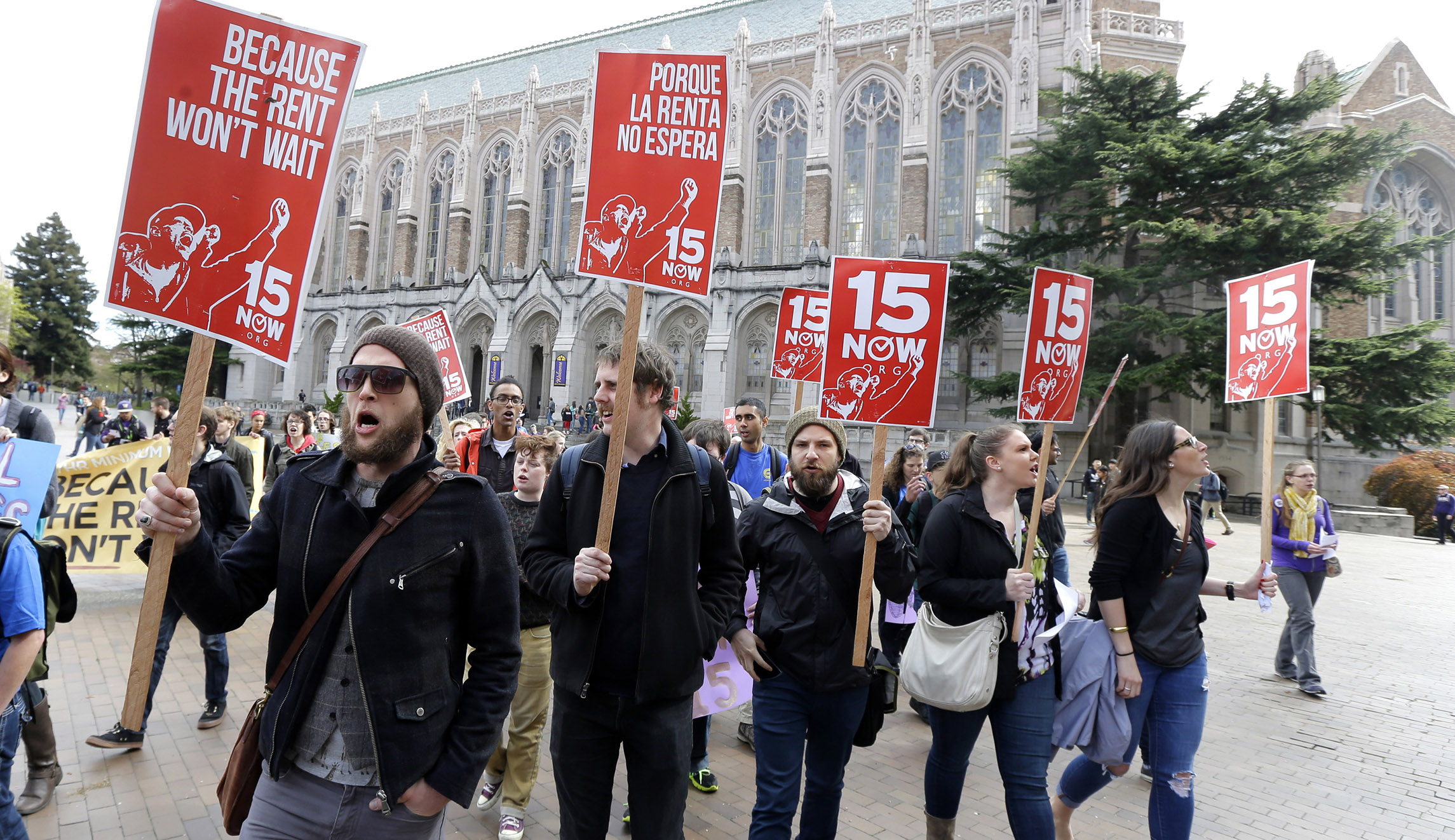
Should the national minimum wage be raised gradually from the current $7.25 per hour to $15 per hour by 2025, as proposed by the Raise the Wage Act? The Congressional Budget Office has shed some new light on the debate surrounding this high-profile bill, which was introduced by Rep. Bobby Scott, D-Virginia, earlier this year and enjoys some support from House leadership.
When this question was posed to a sample of 1,000 registered voters in a January Hill-HarrisX survey, some 55% said yes. Others said yes to a smaller increase. Even stronger positive support was found in a March Hart Research Associates poll of voters in 57 battleground congressional districts won by Democrats in 2018.
Recommended Stories



This small bit of evidence suggests that voters, on balance, favor significantly higher minimum wages. But what if the pollsters had expanded the question a bit by saying that for each person assisted by a mandated higher wage, as many as three might lose their jobs?
Would that have affected the response? I think so.
In a new study, the CBO reported estimates of the employment and income effects of the proposal. These suggest the 2025 minimum wage increase would lift the incomes of 1.3 million workers above the national poverty level. So far, so good. But the other side of the story is that, based on the confidence limits of the estimate, the bill would have a two-thirds chance of eliminating employment for as few as zero to as many as 3.7 million U.S. workers.
The likely number of jobs lost rests somewhere in between, and the median estimate rests at 1.3 million — or one job lost for each worker lifted out of poverty.
How much would below-poverty-line families gain? More good and bad news here.
By 2025, the average below-poverty family assisted by the law would see a $600 increase in annual income. This comes at a cost of lost income for the newly unemployed, higher consumer prices induced by the higher wages, and lower earnings for affected businesses.
We should remember that being in poverty is about one’s income versus what it costs to live in a particular location, and the CBO estimate just focuses on the income part of the equation. Costs of living vary markedly across the United States, as do currently established state minimum wage laws that now exceed the federal minimum in 29 states and D.C. Overall, though, the findings clearly reinforce the unfortunate fact that minimum wage hikes are never free and are not simply borne by wealthy business owners.
So, is there a less-painful alternative for politicians of good will who seek to reduce poverty? The short answer is maybe, and it has no job losses directly associated with it.
The alternate approach, as indicated in the CBO study, is found in the Earned Income Tax Credit provision of the tax code. The EITC allows lower-income individuals and families to file a tax return and receive a check from the federal government. This tax provision could be modified to provide the equivalent of the $600 for the average below-poverty income tax filer. There would be no directly related labor force lay-off of other workers.
Of course, the EITC approach requires that those who benefit be working and filing taxes. Instead of being paid for by the worker layoffs, higher consumer prices, and reduced business profits which hide the real cost, the funding would be paid for by U.S. taxpayers.
Undoubtedly, most elected officials who support the Raise the Wage Act know much or all of this, yet have chosen a more disruptive way to (as they see it) improve the well-being of low-wage workers. Why might that be the case?
First off, a Raise the Wage Act is much easier to understand and communicate than making adjustments to the EITC. It’s a bumper sticker compared to a PDF file. Those running for office can say, “Elect me, and I will do my best to raise the minimum wage and will do so by passing a law.” Enough said.
Perhaps there is also an unstated goal that Raise the Wage supporters hope to achieve: assisting organized labor in districts and states where they have to compete with minimum wage workers. A higher minimum wage enforced by federal law will make life a bit easier for union officials seeking to expand memberships and collect more union dues; the officials will have less labor competition from firms with lower-wage workers. Adjusting the EITC accomplishes nothing of the sort for unions.
What are we to make of the surveys and polls? Most decent people prefer higher to lower wages for themselves and their neighbors. When asked, they tend to express their ethical preferences. Most decent people also don’t like laws that cause people to lose their jobs. With more information of the sort found in the recent CBO study, the Raise the Wage Act should be in for some rough sledding.
This may be the time for the states to continue to show minimum wage leadership. Unpopular though it might be, that means doing the right kind of nothing on minimum wages.
Bruce Yandle is a contributor to the Washington Examiner’s Beltway Confidential blog. He is a distinguished adjunct fellow with the Mercatus Center at George Mason University and dean emeritus of the Clemson University College of Business & Behavioral Science. He developed the “Bootleggers and Baptists” political model.
