

Editor’s note: Sen. Josh Hawley is a client of Brad Todd, who co-authored a book with Salena Zito.
MALDEN, Missouri — Josh Hawley said he had two goals in mind when he decided to spend a week in rural Missouri getting to know his constituents and their communities: listen and learn.
“Oh, and not to talk about politics,” the freshman senator said one day after returning from a weeklong, 800-mile deep dive into 10 of the most rural detached counties in his beloved home state of Missouri.
No politics at all? “Nope. None.” Hawley said he didn’t ask a single person if they voted for him, and he told everyone to just call him Josh.
“We did not discuss politics at all because I didn’t do any talking. I just asked them to tell me about their lives, family, and their community,” he said.
“They did all the talking. It’s funny, I had one or two times, I had somebody say to me, ‘OK, now what is it that you’re here for?’ In other words, what do you want? When are you going to ask me for something? To work for you or give you money or support some cause. And I would just say, ‘I’m here to listen to you, and the only ask I would have is, would you let me tell part of your story?’ I said, ‘It won’t be political. I’m not here to ask for your endorsement for anything. I’m here as somebody who works for you to listen to you,’” he said.
Hawley’s sojourn took him through 10 economically distressed Missouri counties: St. Clair, Douglas, Ozark, Howell, Shannon, Ripley, Dunklin, New Madrid, Butler, and Carter, including two located in the rural, historically black Bootheel region that is more southern than Midwestern in culture, deeply rooted in agriculture and faith.
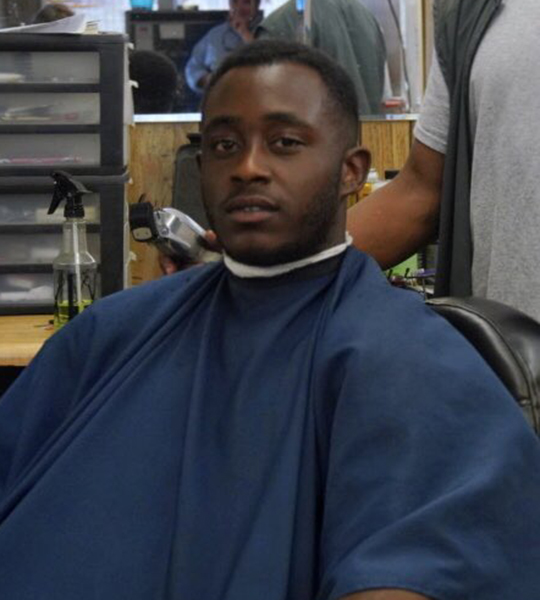
Hawley’s first stop was here in Dunklin County at the New Growth barbershop on Main Street. One of the near-dozen clients waiting for a haircut was Chauncey, who opened up to Hawley for over an hour about his life. Chauncey was very rooted to Malden, born and raised here where he excelled in sports in high school. He found himself lost after high school, but not ready to give up on himself or his community despite the lack of opportunities he could find elsewhere.
Hawley said the weeklong trip began with visiting with the owner Nick.
“Nick grew up in this little town of Malden, about 4,000 people, had a rough time in high school because his father wasn’t around, his mother doing the best she could. He got into some sort of trouble and ended up going to prison. He did some time. When he came out, of course now he’s a convicted felon. He couldn’t get hired anywhere. Nobody wanted to take a chance on a felon. While he was in prison he picked up some barber skills. So he started his own little barbershop,” he explained.
“Now he has several of them, and he continues to run the barbershop in this little town of Malden even though he now no longer lives there. But he commutes there and does his business and as a way to give back to the town, he only charges 10 bucks for a cut so that folks there can afford it,” he said.
“Nick talked to me just about the struggles of, again, lack of economic opportunity, a breakdown of community, his dad not being around and his community with a lot of fathers absent. Moms trying to make it, trying to work a job, trying to raise the kid. And then drugs, drugs everywhere, dealers everywhere, the violence that comes with that,” Hawley explained. “It is the same thing that folks in other towns that were not African American communities said to me.”
Poverty, and all of the heartaches that go with it here in the Bootheel, is colorblind. It affects blacks, whites, and Hispanics, as does a lack of economic opportunity, drug addiction, family collapse, and despair. In the Bible Belt, churches and congregations are often the only things binding these communities together, that and people like Nick, who found a way to create opportunity for himself and others despite a cascade of obstacles.
In rural America, Hawley says there are profound similarities and struggles no matter the skin color. “I don’t want to act as if they’re all exactly the same. But I was struck by how similar it is, here’s the other thing I think is really important. I’ve noticed that the chattering class has started now on this refrain that if you say working class or working people then that’s code for white or that’s code for white nationalism or something. I think not only that that’s factually wrong, it’s actually a very, very dangerous thing to say,” Hawley said.
“This is rural America. This is rural Missouri. The African American folks, they’re proud members of these communities. They’re proudly part of the working class. They’re proud to live in small towns. And to say that any time you talk about working-class needs you’re really just talking about white people actually writes them out of the story. And it divides us by race, which is a dangerous thing,” he explained.

One of the many things that stood out to Hawley was the lack of broadband access, “It’s terrible. In some of the counties I was in, only about 60% of residents have access to the internet. Think about that. Some people have to go to the local McDonald’s to get internet or maybe the local library and all of these towns don’t have a public library, so that is a struggle,” he said.
His laundry list of issues to address from the stories people told him includes access to broadband, well-paying jobs, and healthcare, “A lot of these towns, they certainly don’t have a hospital. Some of them don’t even really have a clinic. And with the drug epidemic, what I heard over and over and again is folks need access to rehab resources that are not two and three hours away.”
On the devastation of drug addiction and the crime that comes with it, Hawley said, “Every single community that I visited is absolutely awash in drugs, particularly in my state in these counties, particularly meth but also heroin and fentanyl. I mean, just awash in it. I talked to folks who themselves struggled with drug addiction, who had family members who struggled with drug addiction. One young woman, a nurse with two young kids, and the father of her first child had committed suicide partly because he had become a drug addict,” he explained.
Often he found himself and whoever he was listening to in tears.
As far as the push from the chattering class for these people to “just move” to where the jobs are like Silicon Valley, Hawley says the chattering class, which is very transient and rootless, doesn’t seem to understand how valuable roots to a community and family is to rural people despite the challenges of work opportunities.
“Every single person was so offended by that,” he said of the relocation solution. “They would say, ‘Wait a minute. My family is here. My life is here. I want to raise my kids here. I should be able to come home in this country and not have to move to some place I don’t know anybody, I don’t have any network of family and friends,”” he explained.
Hawley said what they want is somebody who will treat them with respect, not just to be patted on the head.
“My nightmare scenario is that we develop an economy where the tech billionaires profit. It’s great. It works for them. And people like all of the folks I met in these in little towns, they can’t get good jobs. That is an economy we simply cannot afford to have. That won’t sustain our democracy in the long run. It would be devastating for my state. So I think there’s a very clear link between the behavior of these powerful companies and the needs of the people I represent,” he said of the tech giants Hawley has been strident in taking on since his days as the state attorney general.
As for critics who would call his tour a gimmick, Hawley says this is an important and continuing part of serving his state. “This is my job, meeting with folks, giving them a chance to talk directly to me, and then to tell the rest of the world about some of their stories,” he said, which is why he placed their stories as they happened on social media.
Hawley said many of his visits were planned, including visits with local lawmakers and community leaders, and just as many were spontaneous interactions such as with Chauncey.
At one point Chauncey asked where Hawley was heading next, and Hawley told him Poplar Bluff. Chauncey asked if he could come, but only after insisting he change his clothes.
