

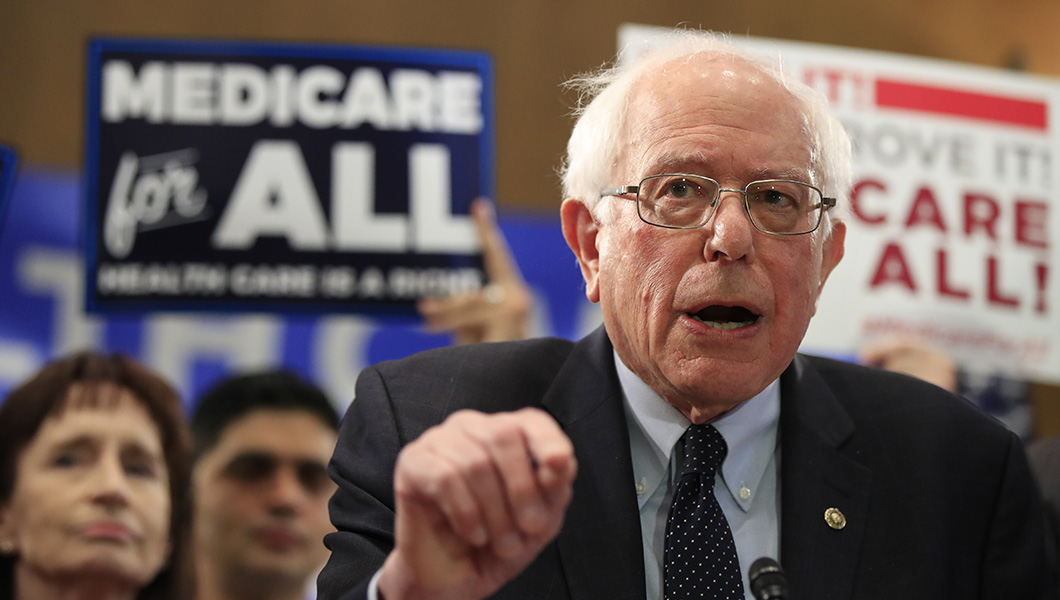
Vermont Sen. Bernie Sanders now has an answer for how he’ll deal with a Republican-controlled Senate if he’s elected president: unilateral executive action.
Sanders’s campaign is reportedly drafting dozens of executive orders that would allow a hypothetical President Sanders to overturn President Trump’s immigration policy and bypass Congress on a wide range of other domestic policy issues, such as healthcare and the environment. Sanders’s top priorities would be to halt construction of the southern border wall, legalize marijuana, and declare climate change a national emergency, according to the Washington Post.
Recommended Stories


This shouldn’t come as a surprise to anyone familiar with Sanders’s campaign. He’s always provided vision, but when asked how he’ll see it through, Sanders has pivoted to an explanation reminiscent of a father chiding his children on a long road trip, with a vague, “We’ll get there when we get there.” Now, Sanders can point to a list of executive orders as proof that the final destination will be reached one way or the other.
Still, Sanders continues to dodge two substantive critiques: how he’ll pay for his trillion-dollar policies and how he’ll get them past Senate Majority Leader Mitch McConnell and a Republican-controlled chamber. Sanders’s inability to answer these questions has led some critics to prematurely conclude that a Sanders presidency would yield few results. Just yesterday, the Washington Post’s Paul Waldman wrote that Sanders’ “social democratic revolution” would be “impossible to bring about” given the current congressional and judicial realities. Thus, a Sanders presidency, Waldman concludes, would achieve “basically nothing.”
Waldman makes some good points. But Sanders’s list of executive orders should serve as a reminder that it will be difficult to stop Sanders once he gets started. The expansion of executive authority over the past few decades has made it easier for presidents to circumvent the separation of powers, and a president committed to the consolidation of power will undoubtedly find a way to work around checks and balances.
Granted, many of Sanders’s executive orders would be challenged in court, and it’s possible that very few would survive the judiciary. Nevertheless, Sanders’s sweeping use of executive authority would dramatically shift the balance of power in Washington. And that in and of itself is cause for concern.
