

The United States has a very significant national security interest in ensuring that Taiwan remains a democratic and independent nation. If Taiwan falls to communist China, America’s credibility as the global bastion for democracy will suffer. Taiwan’s demise will also — after a few years of sanctions on China — encourage a massive recentering of global political relationships in Beijing’s favor.
Recommended Stories


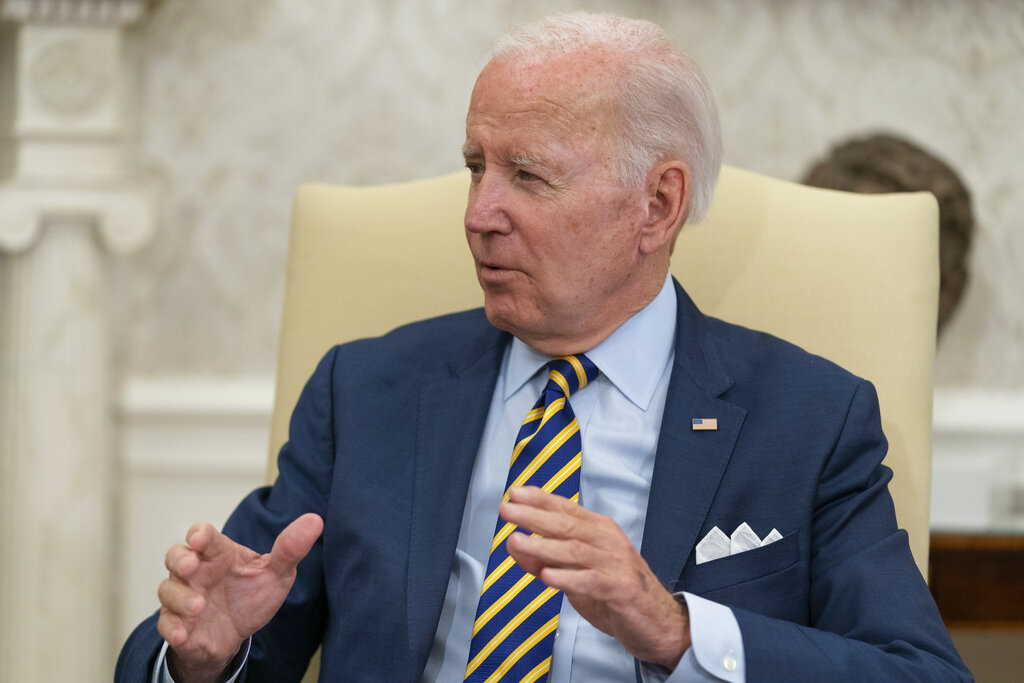
That said, I believe President Joe Biden is wrong to commit to Taiwan’s defense unambiguously. On Sunday, Biden was asked by CBS 60 Minutes’s Scott Pelley, “To be clear, sir, U.S. forces, U.S. men and women, would defend Taiwan in the event of a Chinese invasion?” Biden simply responded, “Yes.”
This is the fourth time since Biden became president that he has committed U.S. forces to defending Taiwan. As previously, the White House implicitly rebuked the president, insisting that the U.S. policy of “strategic ambiguity” over whether it would intervene against any Chinese attack is sustaining. Still, the commander-in-chief responded “yes” when asked whether U.S. military personnel would fight to defend Taiwan. U.S. policy appears to have shifted in dramatic fashion.
The U.S. military and intelligence personnel I have recently spoken to believe that Xi Jinping is likely to order the People’s Liberation Army to attack Taiwan within the 2023-2026 time window. Escalating pressures on Xi, both domestic and foreign, are likely to drive him to grasp for what is necessarily a defining part of his destiny: the reunification of Taiwan with the mainland. In turn, the conduct of China’s escalating harassment of Taiwan’s airspace is now inextricably linked to the PLA’s effort to improve its ability to sever Taiwan rapidly from U.S. reinforcement and to destroy its air and air defense forces quickly. Even if a domestic political presentation is part of his motivation (especially as he approaches critical Communist Party meetings in October), Xi isn’t just putting on a show.
That brings us to the U.S. response to this rising threat. The problem with Biden’s remarks are not their moral substance. Indeed, in principle, the president deserves credit for taking a definitive stance that threads a path between former President Barack Obama’s verbose equivocation and former President Donald Trump’s impulsive bluster. It’s also positive that Australia, Japan, and the U.S. are planning together for any Taiwanese invasion. Britain may soon join these efforts.
The problem is that Taiwan is not doing nearly enough to defend itself against the rapidly growing threat of Chinese invasion. There are two key concerns here.
First off, Taiwan’s defense spending remains ludicrously low in face of the existential threat it faces. This war, after all, would define whether Taiwan remains an independent democracy or just another subordinate province under the Chinese Communist Party hammer. Yet, even as Taipei stares down the vast size and capability of the PLA, it continues to spend less than 2% of its GDP on defense. Even recently announced spending boosts for 2023 are likely to see Taiwan’s total defense spending remain below 2% of GDP. Taiwan should be spending at least five times that amount.
Again, this is a question of Taiwan’s very existence. But it raises a related question for the U.S. — namely, how could an American president justify sending young Americans to die for a faraway land that is not utterly committed to its own survival? Considering the PLA’s oft-underestimated capability to wage a brutal war of attrition and denial against U.S. forces, this moral question is no small concern. Thousands of American service personnel are likely to die in any fight for Taiwan.
The secondary concern is that, although Taiwan’s active military service personnel are showing heroic commitment (and resolution in the face of exhaustion) confronting the PLA’s near daily harassment, much of Taiwan’s population remains effectively idle. To her credit, President Tsai Ing-wen has prioritized improving the pathetic state of Taiwan’s reserve forces readiness. Yet this effort will only succeed if Taiwanese citizens themselves are committed to its success. It’s one thing to tell a pollster that you’re willing to fight and die for your country. It’s a different thing to take painstaking steps to prepare for that eventuality. And the hard truth is that far too few Taiwanese are currently taking those steps.
This is not to say that the U.S. should sit out a war for Taiwan’s freedom. U.S. interests likely demand the opposite choice. But unless and until Taiwan itself ramps up its readiness for war, it’s hard to see how the U.S. can ride to the rescue.
