

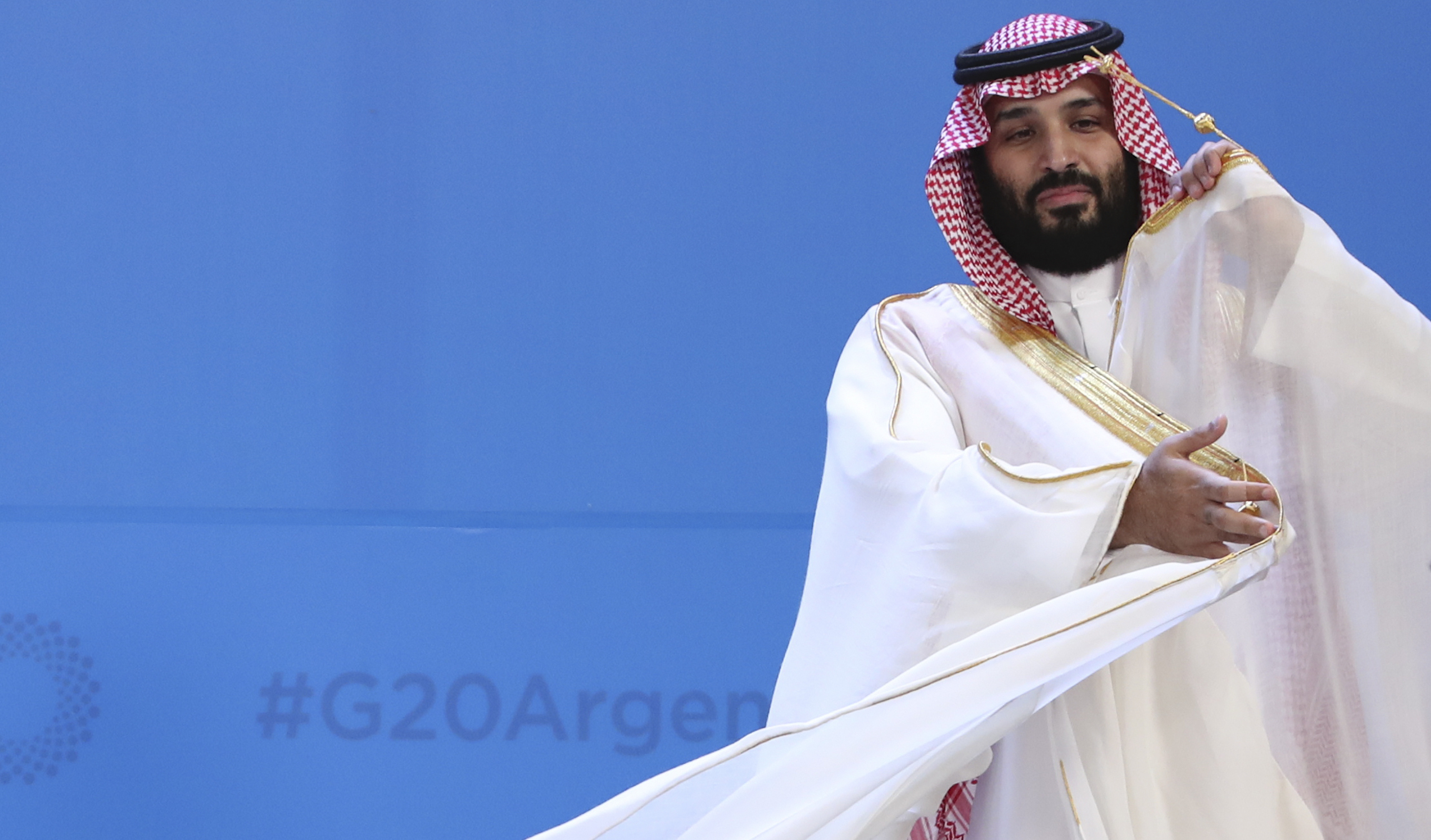
You may remember Mohammed bin Salman as the brash and oftentimes delusional Saudi crown prince who is just as passionate about diversifying his country’s oil-dependent economy as he is about eliminating his opponents.
Seven years ago, MBS was but one of thousands of princes living a pampered but boring life. It turned out that MBS was anything but an ordinary Saudi royal; spending years attached to his father, King Salman, MBS learned how power is wielded inside the kingdom. He was his father’s enforcer, a skill he put to good use in later years as he sidelined his more powerful cousin, Mohammed bin Nayef, as crown prince and heir to the throne. He also successfully shook down richer members of the royal family.
Recommended Stories


MBS still possesses a gleaming self-confidence, but he’s no longer as unabashedly self-assured as before. The man who sat down for a two-hour interview with Saudi state TV this week sounded a lot different than the man who charmed celebrities in Hollywood, courted politicians in Washington, D.C., and solicited investments from Silicon Valley a few years ago. While it would be foolish to overstate the case, it’s hard not to believe that the Biden administration’s policy toward Saudi Arabia doesn’t have something to do with the evolution.
When U.S. Saudi policy was seeing better days (in Riyadh’s view), MBS was tougher in his language and more erratic in his behavior. He called Iranian leader Ali Khamenei the 21st-century iteration of Adolf Hitler, as if Tehran was run by a bunch of maniacal madmen who wanted to turn the entire Middle East into an Iranian colony. In Yemen, he authorized the kingdom’s first major military intervention (others were fought with proxies), predicting the war against the Houthis would be wrapped up in weeks.
The crown prince became increasingly emboldened by a largely passive Trump administration; to take one example, the Lebanese prime minister was all but kidnapped and spirited away to Riyadh and forced to sign his own resignation. Irritated by Qatar’s independent foreign policy, the Saudis enacted an embargo of the gas-rich emirate alongside the United Arab Emirates, Bahrain, and Egypt in the hope Doha would quickly cater to Riyadh’s demands. And of course, there was the assassination of Jamal Khashoggi, the Washington Post columnist killed and dismembered by Saudi intelligence operatives in the kingdom’s Istanbul Consulate.
None of it worked for MBS.
The war in Yemen has turned into a bleeding ulcer for Saudi Arabia, where Houthi resistance and a clumsy, incompetent air campaign have severely hurt the kingdom’s credibility in Washington, D.C. Khashoggi’s murder was the ultimate shot in the foot, a crime as brutal as it was unnecessary. Qatar laughed at Saudi demands and refused to budge, choosing instead to increase economic links with Iran and Turkey, the very powers Riyadh sought to marginalize and weaken with the embargo.
MBS would never admit it, but he appears chastened. Today, he talks openly about making peace with Iran’s Khamenei, the very man he equated to Hitler. “At the end of the day, Iran is a neighboring country,” the crown prince told Saudi TV. “All what we ask for is to have a good and distinguished relationship with Iran.” Iranian and Saudi officials have reportedly launched a dialogue process in the Iraqi capital of Baghdad.
There could be a number of reasons for MBS’s change in tone, many of which have nothing whatsoever to do with the United States. But it defies credulity to believe President Joe Biden’s more balanced approach with respect to the kingdom, one that distances Washington from frivolous Saudi misadventures (such as Yemen) and calls out the Saudi government for indefensible actions, hasn’t affected MBS’s calculus to a degree.
It’s certainly possible that the crown prince is finally learning the lessons of his many mistakes. But it’s equally probable that the soon-to-be king is internalizing the new message Washington has been sending with some success: While the U.S. is willing to collaborate when U.S. and Saudi interests converge, Uncle Sam is no longer going to hold the kingdom’s coat.
Daniel DePetris (@DanDePetris) is a contributor to the Washington Examiner’s Beltway Confidential blog. His opinions are his own.
