

PROSPERITY, Pennsylvania — How this little village earned its name is rooted in an old tale featuring a common last name, one-in-a-million odds, and a likely exaggeration about how many settlers were attracted to the middle of the frontier.
“It was founded in 1848 by a gentleman named Robert Wallace,” explained Clay Kilgore, executive director of the Washington County Historical Society. “When he got the tract of land, he built a house on one of the lots he had laid out and then began selling more lots. It was not exactly the most favorable location for a town. There were a few Native American trails that went down by it, but not to it.”
Recommended Stories



“He really played it up as a sound place for people to kind of make a good living, and the opportunity was there for the taking. The idea was he was going to call it Wallaceton. When he sent his application in for a post office, he boasted how many lots were being sold so quickly.”
Kilgore is skeptical it was as robust as Wallace’s application read.
Kilgore said, “So, the story goes the government came back and told him there was already a Wallaceton in Pennsylvania, so they could not give him that name. But because if, as he said, the lots were being sold so quickly and settlers are coming in as fast as he reported, their suggestion was he call it Prosperity.”
And supposedly, that’s how Prosperity got its name.
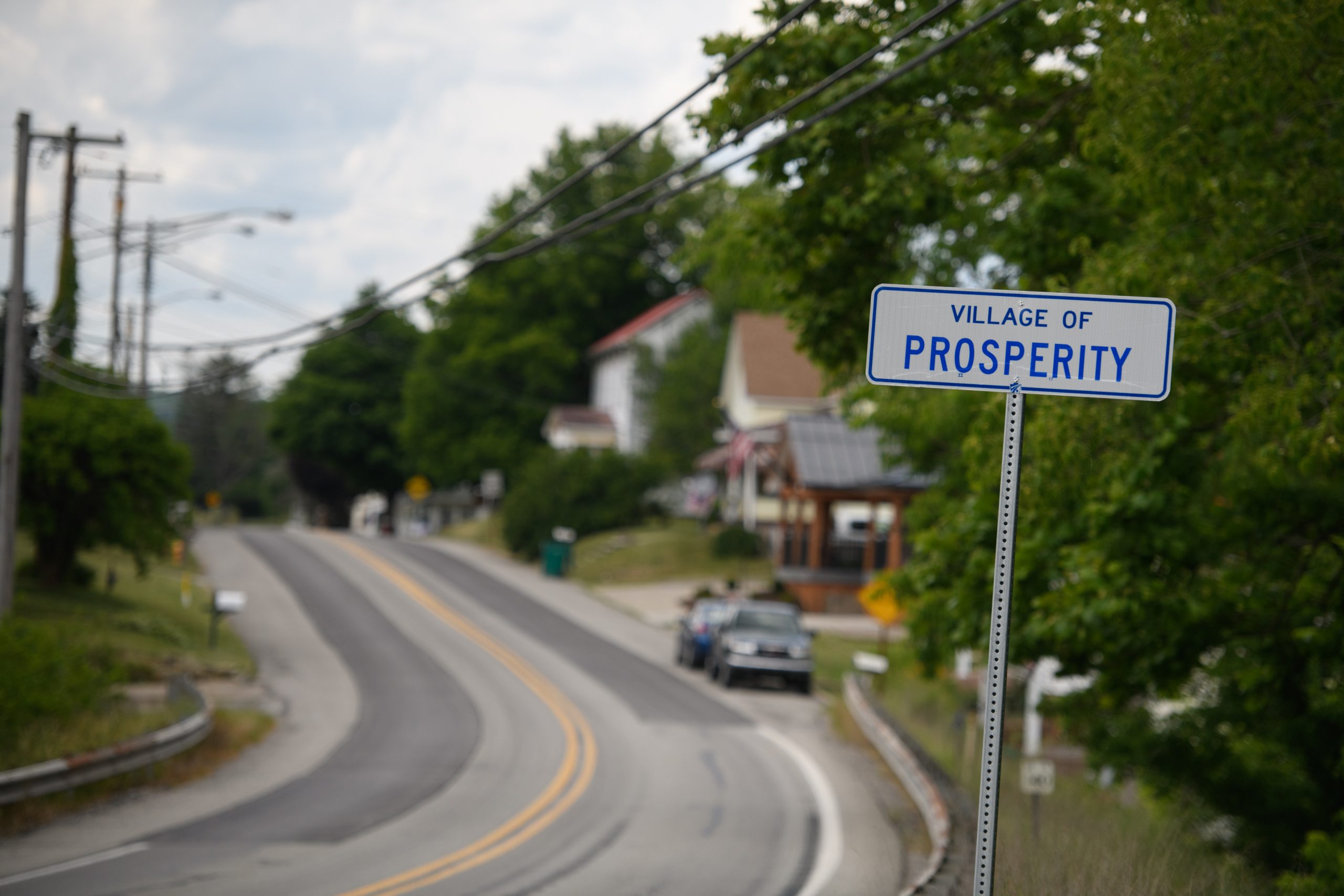
Not much has changed in Prosperity since the 1860s. It has about the same amount of homes, the same amount of people, and the same amount of stores. As Kilgore explained, it doesn’t suffer from the highs and lows as that of cities and other towns because it’s never had an economic burst to fall down from.
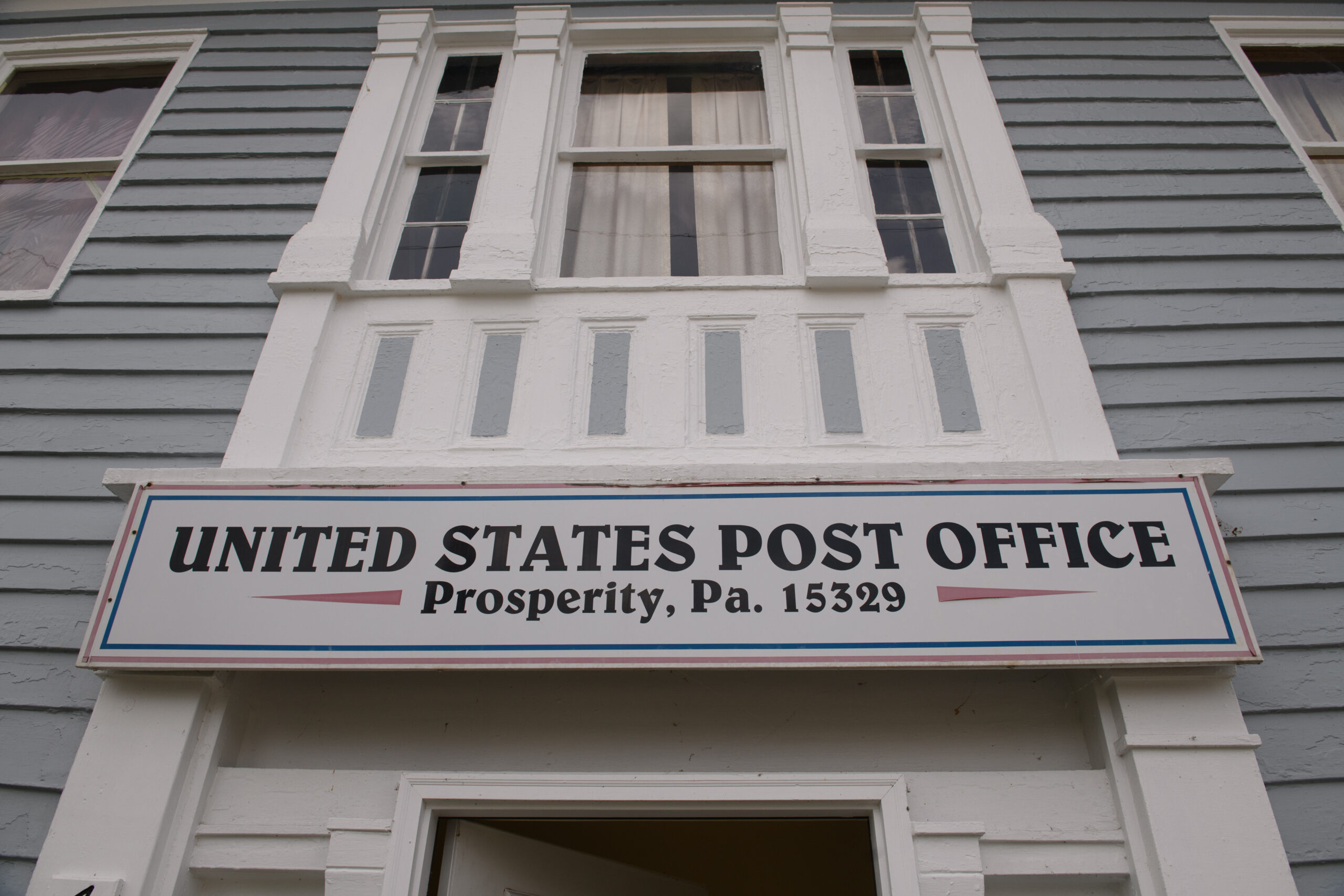
The post office Wallace coveted still stands. It does not bear his name as he so hoped for, but the name Prosperity is just below the “United States Post Office” sign. It is an ancient and charming building, where postmasters have served long careers behind the service window and where the brass post office boxes still greet the locals coming in to pick up their mail.
On a brilliant summer afternoon, the woman behind the window and a woman in the lobby are chatting away, explaining they were just visiting with each other, catching up with the local news.
Just across Prosperity Pike is Marie Phillips’s home, an expansive farmhouse with a broad, latticed front porch, a side porch, shutters on each window, and a neatly cared-for front yard. Earlier this year, a local newspaper wrote about the fanciful collection of gnomes in her garden. The 90-year-old lifetime resident said she sits most of the time in the back, enjoying the rolling pastures of farmland.
Her late husband was the town’s postmaster for years.
“It’s just a nice little town. Not much has changed. We all got along well here when I was a child, and that continued when I married and had my own children,” Phillips explained. “We just did most everything any little town would do and really never felt we wanted for anything that wasn’t right in front of us. We played in our yards, the community had parades, and we went to church.”
“Even though Wallace kind of lied when he said it was a prosperous place, it really did start to grow, to the point where the state legislature actually authorized the construction of a road to connect Washington and Prosperity,” Kilgore said of present-day state Route 18, the longest state road in the commonwealth. “It was a plank road, a wooden road that connected the larger city to this small village. That way, folks could get their goods here easier as well as sell their own goods. And that happened early on, only three years after the town was founded, so it must’ve been doing all right.”
It remains unknown if Marie Phillips’s parents understood how rapidly the world was changing in the months leading up to their daughter’s birth here in November 1929. On Jan. 13 that year, frontiersman Wyatt Earp died. Two days later, Martin Luther King Jr. was born. Earp was a famed lawman and illustrious gunfighter, and King obviously grew up to become a civil rights legend.
That was also the year Herbert Hoover was inaugurated, Babe Ruth hit his 500th home run, the first Academy Awards ceremony was held, Vatican City became an independent sovereignty, Jacqueline Bouvier Kennedy Onassis was born, and the stock market crashed, spiraling the country into the worst economic downturn in history that would last until Phillips was 10.
Nothing was left unmoored, our culture was on fire, civic values were shifting, and the world’s economy had just collapsed — all before baby Phillips was born in this tiny village on the edge of Washington County.
Kilgore pointed to the abundance of early buildings that still exist from the first year of the village’s founding. “A lot of those buildings are still there. I mean, when you drive through it, they may have new facades on them and modern siding, but a lot of those buildings are still there. And you can still find some of the families today that have been here since the first plots were sold.”
Prosperity means different things to different people. Its importance is determined not just by geography, but also popular culture. Is there a trade-off if individuals decide society’s newest measure of what it looks like to be successful? Sure. But no one decision on how you, as an individual, measure prosperity is right or wrong.
For some, that pursuit of good fortune means the ability to provide themselves and their family shelter and food, a decent education, the dignity of a good job, access to healthcare, a place to practice your faith, and having all of your family near you.
For others, that satisfaction means a path to power, a demanding career, and the lucrative bonuses that come with it, the ability to purchase what you want when you want it, a social media profile that influences popular culture, and living in the biggest house in the best neighborhood.
Neither is right or wrong. But you have to wonder if the town of Prosperity was founded today, would it have to look like the latter to be granted that name, or do we still have enough room in our culture to accept all kinds of prosperity?
