

Subscribe today to the Washington Examiner magazine and get Washington Briefing: politics and policy stories that will keep you up to date with what’s going on in Washington. SUBSCRIBE NOW: Just $1.00 an issue!
DEMOCRATS SPARED TRICKY QUESTIONS ON FOSSIL FUELS AT NATION’S OIL AND GAS CAPITAL: The top 10 candidates at Thursday’s third Democratic debate escaped questions on divisive proposals, such as plans for banning fracking and ending the use of fossil fuels — a weird oversight by the moderators considering the debate’s location in Houston, the oil and gas capital of the U.S.
Dietary habits continue to fascinate the media: Instead of asking questions along those lines, co-moderator Jorge Ramos served up the first climate question in the last hour of the nearly three-hour debate to Cory Booker, asking whether more Americans should adopt the senator’s vegan diet to combat climate change.
“No,” Booker said before eagerly switching topics to the war in Afghanistan.
“What one person eats for dinner is far less important than what a candidate sees as the future of fossil fuels,” Jeff Navin, a former chief of staff at the Energy Department in the Obama administration, told Josh.
Navin noted that Texas was a perfect location for a substantive discussion on the energy transition, given not just its reputation for oil and gas, but also its status as the nation’s top wind producer, and a hub for solar.
But Ramos was not done, cooking up a seven-minute discussion on climate change with a generic question directed to Texas’ own Beto O’Rourke on “what meaningful action” he would take to “reverse the effect of climate change.”
O’Rourke pledged “pre-disaster mitigation grants” to Texas communities that are vulnerable to flooding, given that Houston has experienced three 500-year floods in five years, including from Hurricane Harvey in 2017.
However, he then rounded into a rote rundown of his goals, which are not much different from those of the other candidates on stage.
Soft ball questions follow: Ramos set the table for more bland stump speeches, asking other candidates to comment on their plans, without asking a specific question.
“Let’s see if we can go very fast,” Ramos said, seemingly content to merely check the climate box, before opening the floor to Amy Klobuchar, Elizabeth Warren, Kamala Harris, and Andrew Yang.
Ramos, to his credit, asked a follow-up to Warren, on whether U.S. foreign policy should be “based around the principle of climate change.”
Warren said it should, before listing her more aggressive and specific goals of cutting all carbon emissions from new buildings by 2028, eliminating emissions from cars by 2030, and ending emissions from electricity by 2035.
This response, and others, prompted frustration from Democratic observers.
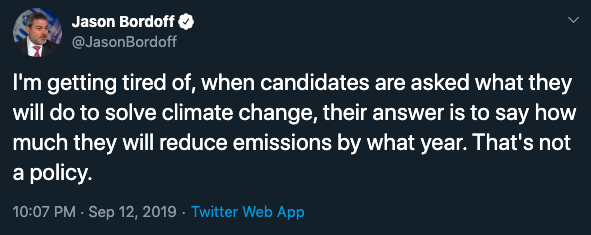
Candidates didn’t forget about climate: The Democrats did, though, weave climate change-related points into unrelated questions.
“Climate change is being recognized by candidates as something central to all these other issues,” Nat Keohane, senior vice president of climate at Environmental Defense Action Fund, told Josh. “It’s not getting treated as a social issue on the sidelines. Candidates are thinking about this and catching up to where voters are, even if debate moderators aren’t doing it yet.”
That was especially true on trade, where many pledged to raise environmental standards in trade deals, and cooperate with China on mitigating climate change.
“I refuse to postpone any longer taking on climate change and leading the world in taking on climate change,” frontrunner Joe Biden said unprompted.
Welcome to Daily on Energy, written by Washington Examiner Energy and Environment Writer Josh Siegel (@SiegelScribe) and Abby Smith (@AbbySmithDC). Email [email protected] for tips, suggestions, calendar items, and anything else. If a friend sent this to you and you’d like to sign up, click here. If signing up doesn’t work, shoot us an email, and we’ll add you to our list.
TRUMP ADMINISTRATION SET TO SELL DRILLING LEASES IN ANWR THIS YEAR: The Trump administration took a final step Thursday toward selling leases for companies to drill for oil in the Arctic National Wildlife Refuge, releasing a finding that energy development would have minimal environmental impact.
The Interior Department hopes to conduct a lease sale by the end of the year, after releasing an environmental impact statement assessing the risks of drilling in a 1.5 million-acre section of the refuge, known as the “1002 area,” where billions of barrels of oil are believed to lie beneath the coastal plain.
It selected the most aggressive of several options as its preferred alternative, proposing drilling in the entire coastal plain.
Democrats and environmental groups have accused the Trump administration of rushing the environmental review and leasing process before the 2020 election, when a Democrat could win the White House and block the planned sales.
“DOI picked the most damaging alternative, with some small tweaks to mitigate a tiny portion of the harm,” Lois Epstein, Engineer and Arctic Program Director of The Wilderness Society, told Josh.
Democrats rebuke Republicans on ANWR drilling: The Interior Department released the review on the same day the Democratically-controlled House voted mostly on partisan lines to bar drilling in the wildlife refuge, overturning a provision in the 2017 Republican tax bill that repealed a long-time ban on energy development. The House bill won’t be considered by the Republican-controlled Senate, however.
The timeline that matters: Actual drilling wouldn’t happen in the refuge for 10 to 15 years even with a lease sale this year, and it’s uncertain how interested energy companies would be in the opportunity, with low oil prices and competition steep from booming oil and gas in the nation’s lower 48 shale regions.
SENATE TO GET ITS OWN BIPARTISAN CLIMATE CAUCUS: Republican Senator Mike Braun of Indiana and Democratic Senator Chris Coons of Delaware are organizing the new caucus, the first bipartisan group on the Senate side dedicated to climate conversations. The caucus is still in the planning stages right now and will be formally unveiled in the coming weeks, according to the senators’ staffs.
Climate change should be a “bridge issue,” Braun told Abby in an interview. He said many Democrats are also looking for a change in dynamic and Republican partners on climate policy.
Braun said he wants to bring his Republican colleagues off the sidelines and “into the game.”
Why the caucus matters: The group’s formation comes as more Republicans are speaking up about climate change and as the polls reveal voters are paying more attention to the issue. And Braun’s leadership shows that Republican interest in finding conservative ways to address climate change extends beyond more centrist members of the party.
But the caucus is also a recognition from lawmakers on both sides of the aisle that they’ll need to work together to craft durable climate policy.
Groups working on climate hope the new Senate caucus can have a similarly positive impact on policy discussions as the House Climate Solutions Caucus, created in 2016, has.
As the senators work out the details for the caucus, they should bear in mind “the more we can make this an issue that bridges the parties, the more successful we are going to be in addressing it,” Daniel Richter, vice president of government affairs for the Citizens’ Climate Lobby, told Abby.
TRUMP’S WOTUS PROMISE DELIVERED, EPA SAYS: The Environmental Protection Agency and the Army Corps of Engineers formally repealed the Obama administration’s 2015 clean water rule on Thursday. EPA Administrator Andrew Wheeler and Assistant Secretary for the Army for Civil Works R.D. James signed the rule during an event at the National Association of Manufacturers headquarters in Washington.
The Trump administration’s rule eliminates the 2015 Obama regulation, known as the Waters of the U.S., or WOTUS. That rule had defined what water bodies are covered under Clean Water Act regulations.
The rollback is a victory for Republicans, industry groups such as the National Association of Manufacturers, and farming groups such as the American Farm Bureau, who staunchly opposed the Obama EPA’s rule as overregulation.
The practical effect of the agencies’ action: The repeal removes Obama-era protections for the 22 states, the District of Columbia, and the U.S. territories that still follow the 2015 rule. Legal back-and-forth had already put the WOTUS rule on hold for the rest of the states in the country.
A former EPA water official says that leaves the states that wanted the Obama-era protections out to dry.
Those states won’t have the resources to head off land developers, oil and gas pipeline developers, and miners from filling in streams or dredging wetlands, Betsy Southerland, former director of the science and technology office in the EPA’s Office of Water from 1984 to 2017, told Abby.
“Once these headwater streams and wetlands are destroyed, they’re gone forever,” she added.
What’s next: The agencies aren’t done. They plan to replace the Obama-era WOTUS with their own definition, which Wheeler says the agencies will finish “this coming winter.” (Remember: EPA uses the seasons broadly. Winter starts Dec. 21 and ends March 20, as Wheeler reminded reporters Thursday).
The agencies’ proposed definition, released last year, would cover less water bodies than the Obama administration’s rule, excluding all ephemeral streams and many wetlands from protections.
NEW CORPORATE CLIMATE COMMITMENT: BUYING NEGATIVE EMISSIONS: Companies are starting to include direct investments in carbon capture and sequestration in their climate and sustainability plans. Shopify, the fast-growing e-commerce platform company, is the latest company to do so, committing to buy $1 million of sequestered carbon annually.
The company wants their investments to help bring down the price of carbon capture and carbon removal, Shopify CEO Tobi Lütke wrote in a blog post Thursday announcing their new commitment. Stripe, an online payment processing company, also made a recent commitment to buy negative emissions.
Noah Deich, executive director and founder of Carbon180, said the commitments from Shopify and Stripe flip the script on traditional carbon offsets, and he hopes more companies follow their lead.
“It shows how all companies can reduce emissions with proven solutions today while catalyzing the commercialization of carbon removal technologies that are essential for meeting climate goals,” he told Abby in an email.
CONSERVATIVE GROUPS CALL ON TRUMP TO END ‘SPECIAL FAVORS’ FOR ETHANOL: A coalition of 16 conservative groups warned Trump administration officials on Thursday not to move forward with proposed fixes to the Renewable Fuel Standard, calling for “special favors for the ethanol industry to end.”
President Trump is expected soon to increase federal mandates for production of corn-based ethanol and biodiesel in order to quell complaints from farmers about the administration’s policy of exempting some small oil refineries from RFS requirements to blend billions of gallons of corn ethanol into gasoline.
“This continued whining by the ethanol lobby shows just how broken the renewable fuels mandate is,” groups including the American Energy Alliance, FreedomWorks, Heritage Action For America, and the Competitive Enterprise Institute wrote in a letter to Wheeler, OMB Director Mick Mulvaney, Energy Secretary Rick Perry, and Secretary of Agriculture Sonny Perdue.
Also Thursday, eight oil-state Republican senators, including Ted Cruz of Texas and John Barrasso of Wyoming, sent a letter to Trump warning his proposed actions would have a “costly impact on consumers, the American refining sector, and thousands of jobs in our home states.”
Corn farmers and their representatives in Congress have accused EPA of excessive use of the refinery exemptions, which they argue are eroding the market for ethanol.
HURRICANE-RAVAGED BAHAMAS FACES NEW TROPICAL STORM THREAT: The Bahamas may face more hardship as a developing tropical disturbance approaches, less than two weeks after Hurricane Dorian hammered the island chain, the Washington Examiner’s Daniel Chaitin reports.
The government of the Bahamas has issued a Tropical Storm Warning for a slew of northwestern islands, including the Abacos and Grand Bahama Island.
In its 5 p.m. advisory on Thursday, the National Hurricane Center said the low pressure system is expected to become a tropical storm and bring tropical storm-force winds to the northwestern Bahamas in the next 36 hours.
AGENCIES BUST DEFEAT DEVICE MAKER: The EPA and the Department of Justice caught another company red-handed with defeat devices that bypass emissions controls for heavy-duty trucks. The agencies announced a settlement with Performance Diesel Inc. on Thursday that requires the company to stop sale of all products the government says violate the Clean Air Act and pay a civil penalty of $1.1 million over two years.
Performance Diesel manufactured and sold aftermarket defeat devices, “and as a result thousands of heavy-duty trucks now operate without the filters, catalysts and other emissions controls that keep our air clean,” EPA enforcement chief Susan Bodine said in a statement.
The EPA says the settlement is part of its national initiative to stop defeat devices in the motor vehicle sector.
DEMOCRATS INVITE GRETA THUNBERG TO TESTIFY BEFORE CONGRESS: Heads-up: Swedish climate change activist Greta Thunberg, 16, is testifying before Congress next week at the invitation of House Democrats.
The Rundown
New York Times Extreme weather displaced a record 7 million in first half of 2019
Reuters: Occidental CEO calls for new US laws to boost carbon capture
S&P Global A fresh prince of OPEC brings a change in Saudi oil diplomacy
Calendar
TUESDAY | SEPTEMBER 17
7 a.m. to 6 p.m (central time). Westin Houston Memorial City, Houston, Texas. The Center for Offshore Safety hosts its Seventh Annual Forum.
9:30 a.m. 366 Dirksen. The Senate and Energy and Natural Resources Committee holds a hearing on examining “the sourcing and use of minerals needed for clean energy technologies.”
WEDNESDAY | SEPTEMBER 18
10 a.m. 2123 Rayburn. The House Energy and Commerce Climate Change Subcommittee holds a hearing on reducing industrial greenhouse gas pollution.
10 a.m. 2172 Rayburn. The House Foreign Affairs Subcommittee on Europe, Eurasia, Energy, and the Environment and the House Select Committee on the Climate Crisis hold a joint hearing on “voices leading the next generation on the global climate crisis.”
THURSDAY | SEPTEMBER 19
10 a.m. 2318 Rayburn. EPA Administrator Andrew Wheeler testifies in a hearing before the House Science Committee.
