

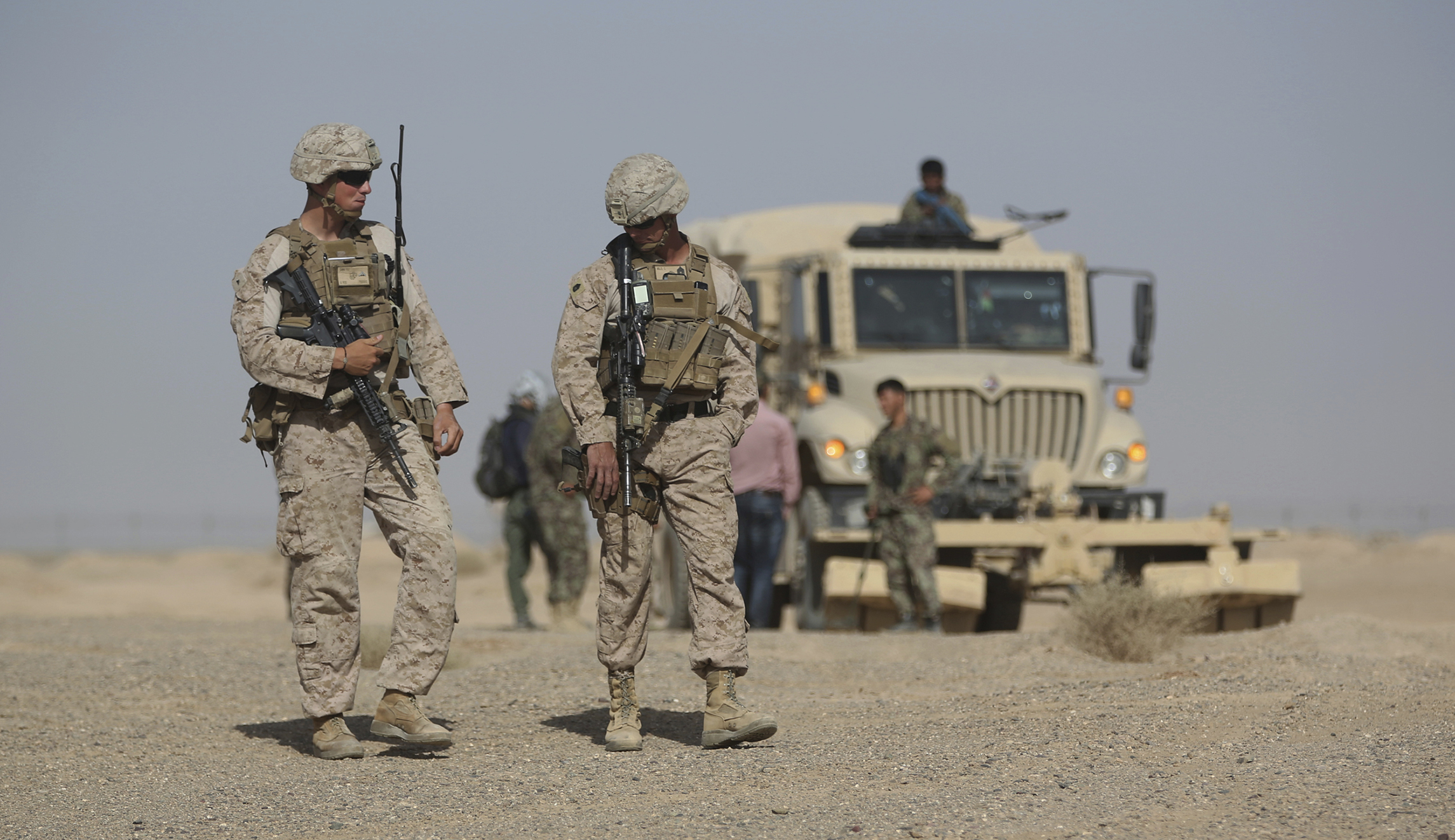
The administration’s top Afghanistan auditor threw cold water on President Trump’s plan to broker peace and quickly withdraw American troops from the country, saying that the process might not even begin for years.
“If there is ever to be a true, sustainable peace in Afghanistan, reintegration of the Taliban and other combatants will be a necessary component of that process, whether that process begins days — or years — from now,” John Sopko, the Pentagon’s special inspector general for Afghanistan reconstruction, said Thursday.
Recommended Stories


“[E]ven if an intra-Afghan political settlement is reached, Afghanistan’s problems will not magically disappear the moment the ink dries on an agreement,” he said. “A failure to reintegrate combatants of all stripes into Afghan society will only lead to the continuation of a 40-year cycle of war that has led to generations of Afghans growing up knowing only death and destruction.”
Those remarks, accompanying his report on the difficulty of bringing 150,000 former fighters into civil society and the job market, wave a caution flag at the idea that a peace deal will end the terrorist attacks that provoked the U.S. invasion in 2001. Sopko said that the reintegration process is essential, but he warned against even attempting to begin the effort as long as the Taliban continues to carry out terrorist offensives.
“As long as the Taliban insurgency continues, the U.S. should not support a comprehensive program to reintegrate former fighters, because of the difficulty in vetting, protecting, and tracking former fighters,” Sopko said.
The Taliban has executed a steady barrage of terrorist attacks even while negotiating with Zalmay Khalilzad, the State Department’s point man for the talks, over the last year. That violence derailed President Trump’s plan to host leaders of the terrorist group at Camp David in Maryland when a Taliban car bombing in Kabul, Afghanistan, killed an American soldier and 11 others in the days between Khalilzad’s finalization of a draft agreement and the intended huddle in the United States. But Secretary of State Mike Pompeo said “I hope we get them started back,” as a drawdown of U.S. forces from Afghanistan remains a top priority for the president.
“The level of diplomatic engagement by the United States with the Taliban and Afghan government in recent months suggests that it would be prudent for policymakers to consider now what reintegration might look like following a peace agreement between the Afghan government and the Taliban — rather than wait until the ‘day after’ an agreement is signed,” Sopko said.
Khalilzad’s efforts reportedly produced a draft agreement in which Trump would withdraw some American forces in Afghanistan in exchange for a pledge that the Taliban would not allow al Qaeda to stage terrorist attacks from the country. That “agreement in principle” was supposed to set the table for direct talks between the Taliban and the central government in Kabul, which the terrorist group has never recognized as a legitimate authority.
Such an agreement will not eliminate the threat of terrorism emanating from Afghanistan without a successful reintegration of Taliban fighters and Afghan refugees living abroad, Sopko said, especially in light of the fact that the Islamic State has established a particularly dangerous offshoot in the country.
“[M]any Taliban struggle to imagine a life beyond the insurgency and want to retain the movement’s military power,” he said. “The potentially tens of thousands of Taliban who do wish to reintegrate will face the obstacles of a weak economy, ongoing insecurity, and local conflicts driven by tribal disputes and unresolved grievances. Islamic State-Khorasan could also attempt to recruit disgruntled Taliban fighters who find fault with the terms of a peace deal.”
