

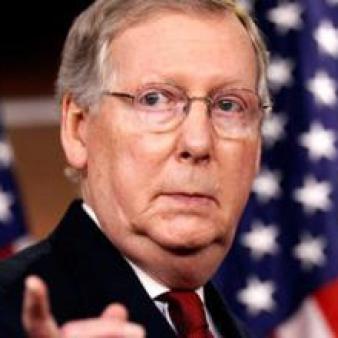
In a speech delivered this morning, Senate minority leader Mitch McConnell blasts President Obama’s foreign policy for making America weaker.
“[W]e’ve all seen how eager the President was to declare an end to the War on Terror,” McConnell said, according to a draft of his prepared remarks.
Recommended Stories


“But as the President was focused on unwinding or reversing past policies through executive order, the threat from Al Qaeda and affiliated groups only metastasized. Uprisings in North Africa and the broader Middle East resulted in additional ungoverned space in Syria, Libya, Egypt and Yemen. There were prison breaks in Iraq, and Pakistan, and Libya, and the release of hundreds of prisoners in Egypt. Terrorists also escaped from prisons in Yemen, a country that’s no more ready to detain the terrorists at Guantanamo today than they were in 2009.”
McConnell blasts the president for responding to the growth of terrorism by drawing down. “The President’s response to all this has been to drawdown our conventional forces and capabilities, and to deploy Special Operations Forces in economy of force train-and-assist missions across the globe. Speaking at West Point in May, he pointed to a network of partnerships from South Asia to the Sahel, to be funded by a $5 billion counterterror partnership fund for which Congress has yet to receive a viable plan. And in those cases where indigenous forces prove insufficient, and a need for direct action arises, the President announced his intent to resort to the use of armed unmanned aerial vehicles for strikes, as has been done in Yemen and Somalia. By deploying Special Operations forces, the President hoped to manage the diffuse threat posed by Al Qaeda in the Arabian Peninsula, Boko Haram, terrorist networks inside of Libya that now threaten Egypt, the Al Nusrah front, the Taliban, ISIL and other terrorist groups.”
And, as McConnell points out, Obama has been “consistent” regarding one aspect of his national security policy: “drawing down our conventional and nuclear forces, withdrawing from Iraq and Afghanistan, and placing a greater reliance upon international organizations and diplomacy.”
