

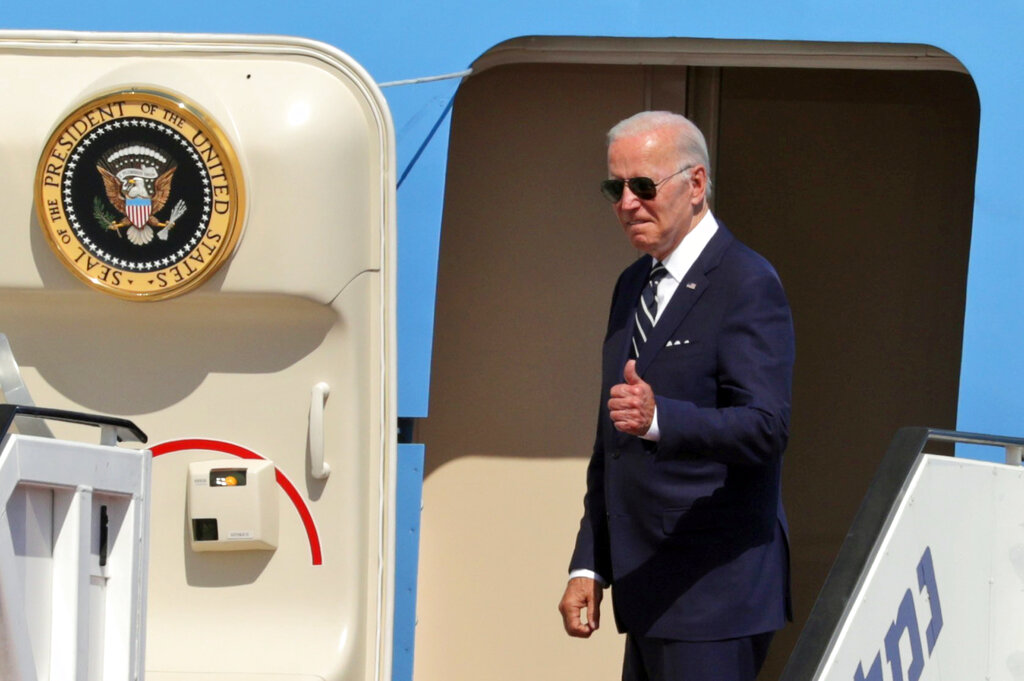
JEDDAH, Saudi Arabia — After downplaying and dodging the prospect of meeting Saudi Arabian leaders, President Joe Biden will meet face to face with Saudi King Salman and Crown Prince Mohammed bin Salman on Friday for closely watched talks on energy, climate change, and steps toward closer regional cooperation.
Recommended Stories


Arriving in Jeddah on Friday, Biden faces challenging dynamics that are likely to stand in stark contrast to the warm embrace he received from Israeli officials. At stake is the possibility for Saudi Arabia to boost its oil output, easing political pressure on Biden, and a human rights mandate that the president has held up as a matter of principle.
KHASHOGGI WIDOW WANTS BIDEN TO UPHOLD HUSBAND’S LEGACY, NOT HURT SAUDI RELATIONS
The trip emerged “as a strategic decision the president made to make sure that the United States was firmly planting its flag in this region for the long term,” White House national security adviser Jake Sullivan said aboard Air Force One on Friday. “The Middle East remains a strategically vital region.”
On Saturday, Biden will attend a Gulf Cooperation Council summit of regional oil producers, and the energy discussion will lead the agenda.
“You know Joe Biden. He feels very strongly about direct engagement,” Sullivan said.
But after promising to make the “pariah” kingdom “pay” for the 2018 murder of journalist Jamal Khashoggi, Biden’s decision to meet with the crown prince has drawn the most scrutiny.
“Biden is looking forward to Saudi like a root canal,” said Aaron David Miller, a senior fellow at the Carnegie Endowment for International Peace and former U.S. negotiator for Republican and Democratic administrations. “He’s very conflicted. And you can see it, you can hear it, and every time someone asks him, ‘Why are you going to sit with MBS?’”
He continued: “’Oh, I’m not going to meet with MBS. I’m going to an international meeting. I’m there to talk about security, American interests. MBS will be there.”
It is not clear how much Biden can deliver for the people.
Leaders in the Gulf have largely resisted the president’s calls to pump more oil, even as prices squeeze the coalition Washington is leading against Russia over its invasion of Ukraine.
And he has not said whether he intends to raise the name of Khashoggi.
Not a second of Biden’s visit with Saudi leaders is likely to escape attention.
Attention on Biden’s visit has been building for months, framed by the president’s fiery rebuke of Saudi Arabia’s human rights record during the 2020 campaign.
The Saudi government has “very little redeeming social value,” Biden said during a Democratic primary debate in 2019.
Biden has struggled to bat back questions about his reasons for meeting the crown prince. The White House for months insisted that Biden would meet only with Salman, his counterpart.
As sanctions on Russian fuel sent gasoline prices soaring, the president’s reluctance to engage Saudi leaders appeared to recede.
Still, the White House and Saudi Arabia have sought to tamp down expectations that Gulf energy producers will pump more oil.
Persuading Saudi Arabia to release additional barrels “is not the purpose of the trip,” Biden insisted in advance of his leaving. And on Friday, Sullivan said not to expect “a particular announcement.”
Biden also downplayed his meeting with the crown prince, whom a U.S. intelligence report said was responsible for the death of Khashoggi, who arrived at a Saudi Consulate in Istanbul one day in 2018 and never reemerged.
From the start, the White House’s framing stood at odds with the visit presented by the Saudi government, omitting a meeting between Biden and the crown prince that the Gulf kingdom had billed as “official talks.”
Asked to explain the discrepancy Tuesday, White House press secretary Karine Jean-Pierre said the president “is going to see over a dozen leaders on this trip. … We can expect the president to see the crown prince as well.”
The optics of that meeting remain a point of sensitivity for a president who had sought to draw sharp lines between democracies and other forms of governance, such as when he refused to invite several autocrats to a U.S.-hosted summit last month.
Aboard Air Force One to Israel for the president’s first stop on Wednesday, White House officials said that due to the threat of the coronavirus, Biden would not be shaking any leaders’ hands.
Sullivan said foreign leaders have adopted “different iterations, different manifestations” of COVID-19 protocol during the pandemic. The current phase demands reduced physical contact, Sullivan added.
Asked whether the president was seeking to avoid a picture shaking hands with the crown prince, Jean-Pierre responded that the advice was on the president’s doctor’s orders.
CLICK HERE TO READ MORE FROM THE WASHINGTON EXAMINER
Pressed again on whether Biden and the crown prince would shake hands, a senior administration official said Thursday that the visit is “about meetings, not greetings.”
Biden cast the rule aside almost immediately.
