

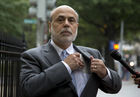
Former Federal Reserve Chairman Ben Bernanke’s latest career moves have some experts concerned about the proverbial “revolving door” between government agencies and the businesses they regulate.
A little more than a year out of office, Bernanke announced that he would consult for the hedge fund Citadel, and then last week announced that he also had been hired by the bond giant Pimco.
Recommended Stories



It’s a typical path for an official following a career at the central bank. Nevertheless, Bernanke’s decision to announce two consulting roles in quick succession has raised some questions about what is and isn’t proper for a former Fed chairman to do.
“This is all part of the decline, really, of professional ethics across the board,” said Edward Kane, a finance professor at Boston College who has written critically of the close relationship between regulators and the finance industry.
Bernanke left the Fed in January 2014 after eight years as chairman and then joined the Brookings Institution, a nonprofit think tank, as a fellow. For the past year, he has worked on a memoir of his time at the Fed and the financial crisis set to be published in the fall. He also earned income giving speeches for financial groups.
Bernanke has defended working for financial companies, telling Reuters that “the Fed does not regulate Pimco or its parent or any other firm that is affiliated with it.”
“I am not going to be involved in any kind of lobbying or any kind of influence with the Fed or Congress or anybody else in the government,” he added.
Although Citadel and Pimco are not directly regulated by the Fed, they have been tangled up in the central bank’s business throughout the years. As documented by the Wall Street Journal, Citadel’s business was influenced by the Fed’s rulemaking following the 2010 Dodd-Frank financial reform law and in theory could be subjected to Fed oversight in the future. Pimco also aided the Fed in conducting the bailouts during the financial crisis.
Although Bernanke will not be lobbying the Fed on behalf of those firms, the incentives created by the prospect of lucrative employment following public service worry economists, some of whom have argued for a five-year ban for regulators taking finance-sector jobs after leaving office.
Kane noted that regulators face the calculation that they can enrich themselves in the future with business-friendly conduct while in office. He cited Bernanke’s payments from financial firms for speeches as especially problematic. “We really need to change incentives within the industry and in government to serve taxpayers better,” he said.
Robert Hockett, a professor at Cornell Law School, said the problem of the incentives created by the revolving door and by regulatory capture is a difficult one. “I end up sort of wondering is there any sort of magic formula that’s going to take care of the problem,” he said.
Regulators who are paid less than their private-sector counterparts have reason to position themselves for a job at a company they oversee. They also suffer a “prestige disadvantage” to people they are supposed to be able to regulate, creating the possibility of conflicts of interest or regulatory capture throughout the large regulatory system, Hockett noted.
Yet most legal remedies to the problem, such as proposals to prevent regulators from entering the industry they oversee, are unworkable, Hockett suggested. Either they’re too narrowly written, and ineffectual, or too broadly written, and prevent knowledgeable and competent people from going into government for fear of not being able to get any job later. Instead, he suggested that Congress might consider a mix of restrictions and boosting regulators’ pay.
Norbert Michel, a financial regulation researcher at the Heritage Foundation, a conservative think tank in Washington, said “there’s no way to avoid this so-called revolving door thing to go on,” citing the massive amount of complex rules applying to financial firms.
Michel called the logistics involved in legislatively ending the revolving door a “nightmare,” warning that efforts to keep people in government rather than going to the private sector would result in a lack of relevant knowledge at agencies.
Aside from questions about the incentives created by financial industry payouts, University of Oregon economist Mark Thoma raised another concern with the precedent set by Bernanke in a CBS column published Monday. Although his second term as chairman was over, by leaving the Fed before his 14-year stint as governor had ended, Thoma argued, Bernanke undermined one of the sources of the central bank’s independence from Congress and the executive branch.
Fed governors and regional bank presidents have long terms, 14 years and six years, respectively, to allow them to serve longer than the lawmakers who appoint them. Bernanke’s decision effectively to take a private-sector buyout to leave early, Thoma wrote, “sets a bad precedent because it encourages other board members to do the same.”
