

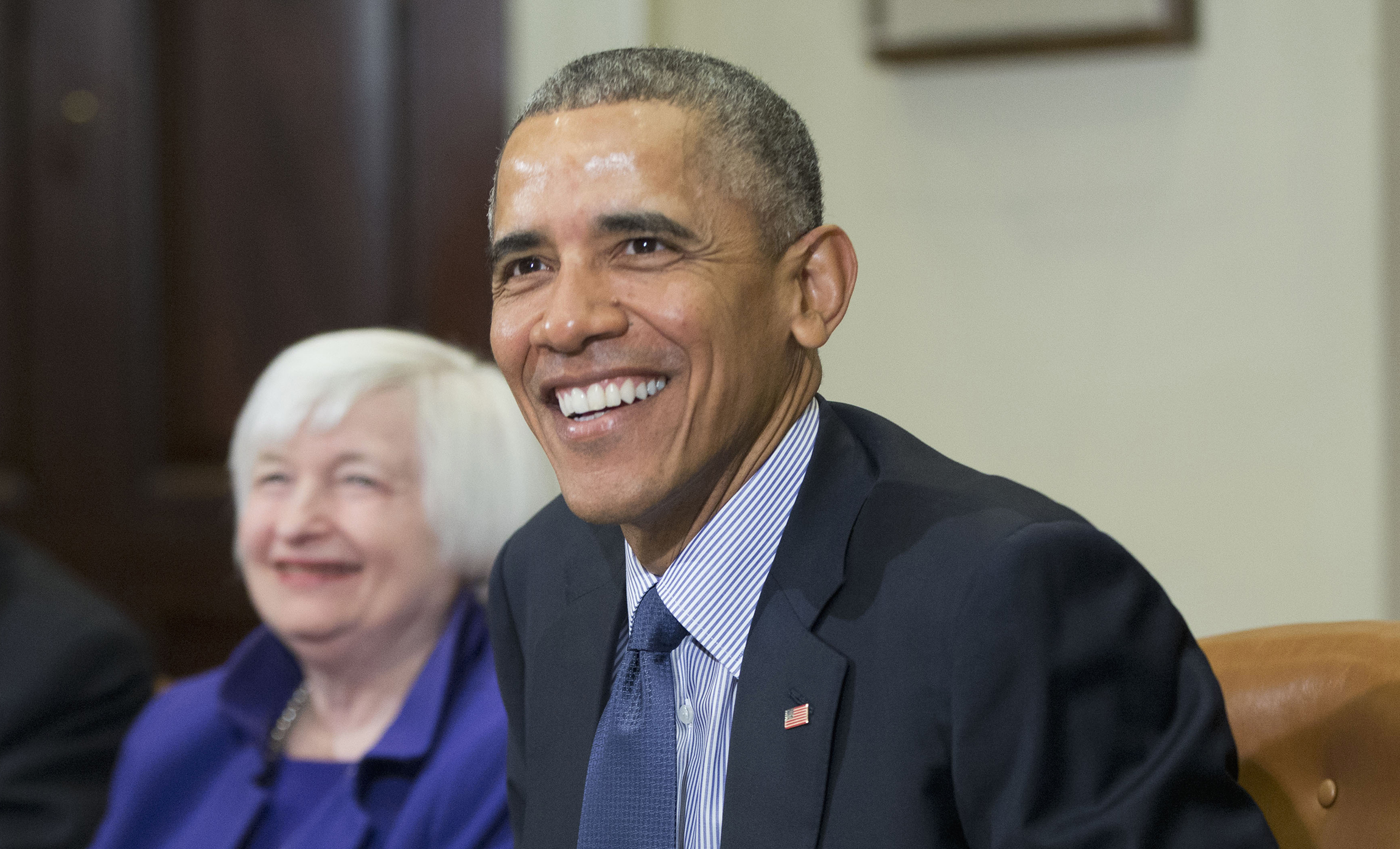
President Obama is happy with Janet Yellen’s conduct as head of the Federal Reserve, according to a White House careful not to infringe on Yellen’s independent management of monetary policy.
Obama “has been pleased with the way that she has fulfilled what is a critically important job,” White House press secretary Josh Earnest said Monday, ahead of a meeting between the president and Yellen at 1600 Pennsylvania Ave.
Recommended Stories



“I think that, independently, people across the ideological spectrum, at least when it comes to politics, would acknowledge that she has filled this very important role quite well,” Earnest added, choosing his words carefully to avoid commenting on Yellen’s monetary policy decisions since Obama appointed her as chairwoman in 2014.
Obama and Yellen did not talk about the money supply in their meeting, but did discuss “both the near and long-term growth outlook, the state of the labor market, inequality, and potential risks to the economy, both in the United States and globally,” according to the White House. They also discussed the implementation of Obama’s 2010 financial reform law.
Monday marked the second meeting between the two in as many months. Congressional Republicans have said that the Fed, which is an independent central bank, is unduly influenced by the executive branch and have faulted Yellen for speaking publicly on the issue of inequality, which they say is a hobbyhorse of Democrats.
In both meetings, Obama and Yellen discussed the state of the banking system, over which the Fed has broad regulatory authority. Both have said in recent months that the financial system is safer now under the new rules.
In discussing the state of financial reform with reporters, Earnest defended the lack of prosecutions for high-level financial executives in the wake of the financial crisis.
“What I can say is that people who have taken a close look at the financial crisis that this country endured in 2007 and 2008, many of them concluded that the problem was not predominantly that individuals were engaged in illegal activity,” Earnest said. “But, rather, that the risky bets that they were making were entirely legal.”
