

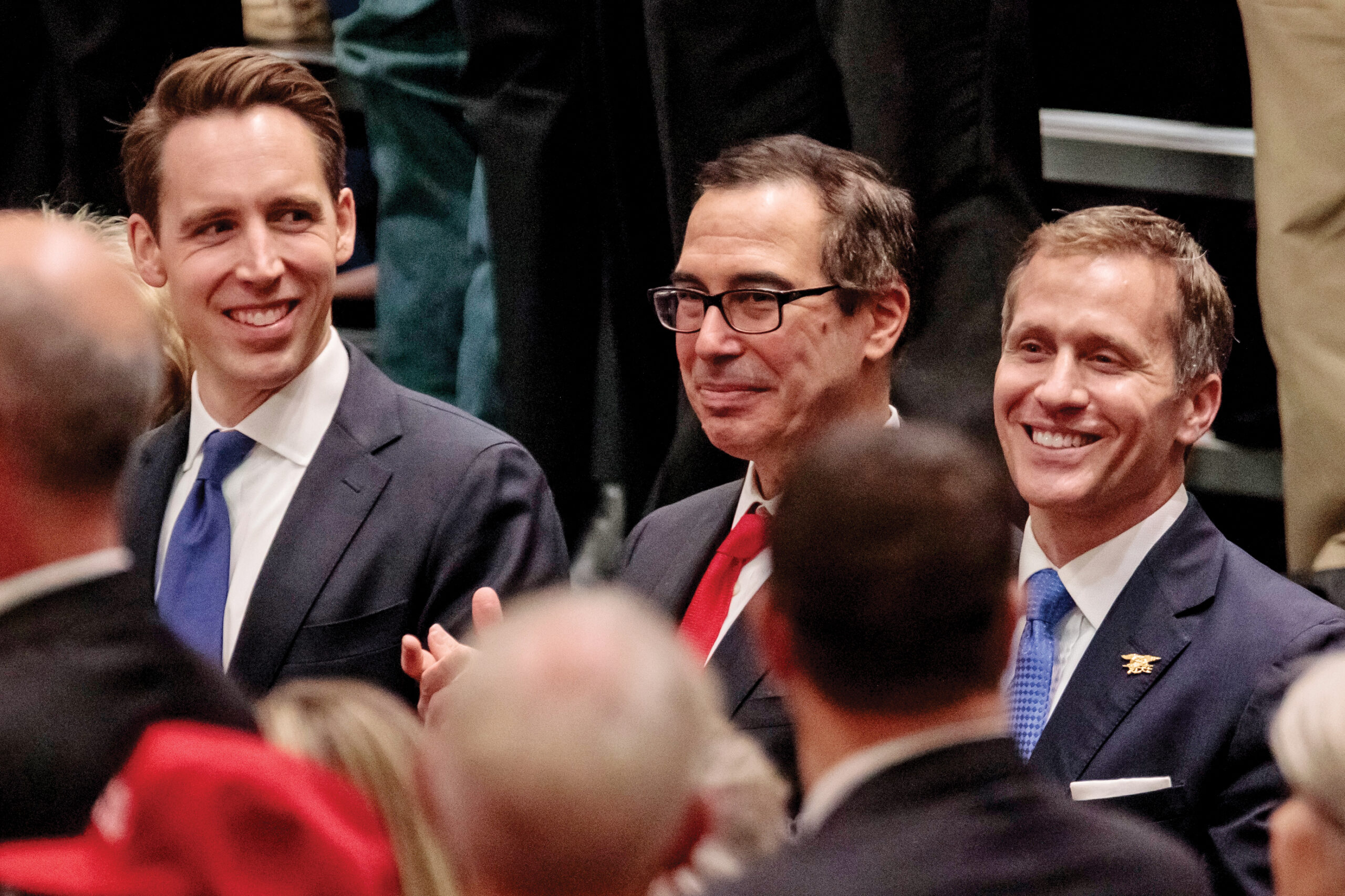
Treasury Secretary Steven Mnuchin on July 30 acknowledged to the New York Times that the administration is considering a substantial de facto cut in the capital-gains tax. The change wouldn’t happen through legislation, the Republicans’ majority being far too thin for that, but by regulatory fiat. “If it can’t get done through a legislation process,” Mnuchin told the Times, “we will look at what tools at Treasury we have to do it on our own and we’ll consider that.”
The idea would be to index capital gains for inflation. If you bought a stock for $1,000 in 2000, say, and sell it in 2018 at the price of $2,500, you pay a tax on the $1,500 capital gain. But inflation has increased by about 46 percent over the last 18 years, so that investment of $1,000 was worth around $1,460 in today’s money. Indexing capital gains would mean you are taxed only on $1,040, not the full $1,500. In cases in which the asset has vastly appreciated over a long period, the difference in tax liability would be substantial.
Recommended Stories



Treasury would effect the change by reinterpreting the term cost in the tax code—the “cost” of purchasing an asset in 2000 would be adjusted for inflation. That is certain to invite legal challenges, but there are legitimate arguments for the change. The language of the statute doesn’t specifically require “cost” to mean the amount of the original purchase. In Mayo v. United States(2011), the Supreme Court unanimously ruled that Treasury had the right to interpret the word student in the tax code to exclude people working 40 hours a week or more. The High Court in Mayo relied on the 1984 Chevron decision that gives agencies flexibility in the interpretation of vague statutes. Hence, say supporters of regulatory indexing, Treasury can interpret “cost” in a way that accounts for inflation.
Yet the word cost in the tax code has little of the flexibility of the word student. The latter term might include almost anyone and, for purposes of taxation, requires a highly technical definition. The plain meaning of the word cost—the amount you pay for a thing at the time of purchase—needs little elaboration.
That’s why, in 1992, the George H.W. Bush administration concluded that it did not have power unilaterally to reinterpret the word in this way. The Chevron doctrine, wrote then-assistant attorney general Timothy Flanigan in a memo agreeing with Treasury’s conclusion, “does not furnish blanket authority for the regulatory rewriting of statutes whenever a dictionary gives more than a single definition for a statutory term. . . . Such a reading of Chevron would eviscerate the well-established rule of construction that statutes must be accorded their plain and commonly understood meaning.”
We don’t doubt that lowering the capital-gains tax on long-term investments would generate real benefits—and encourage the type of value investing which drives our economic success. But we wonder if these benefits are worth the practical and political costs of trying to set tax policy by regulation or executive order. On a practical level, the Power of the Purse belongs to Congress.
As a matter of politics, Republicans already struggle to overcome the accusation that they do the bidding of the very rich. This accusation can’t entirely be avoided in a pro-business political party. But why give it credibility with a unilateral move that risks being reversed in the courts anyway? Indexing capital gains for inflation is a complicated policy to defend, and Democrats won’t find it hard to criticize as a tax cut for the wealthiest taxpayers.
There are cogent conservative arguments for reducing capital-gains taxes. We believe every tax ought to be reduced (and government scaled back accordingly). But the Treasury Department isn’t the place to do it. Congress is.
