

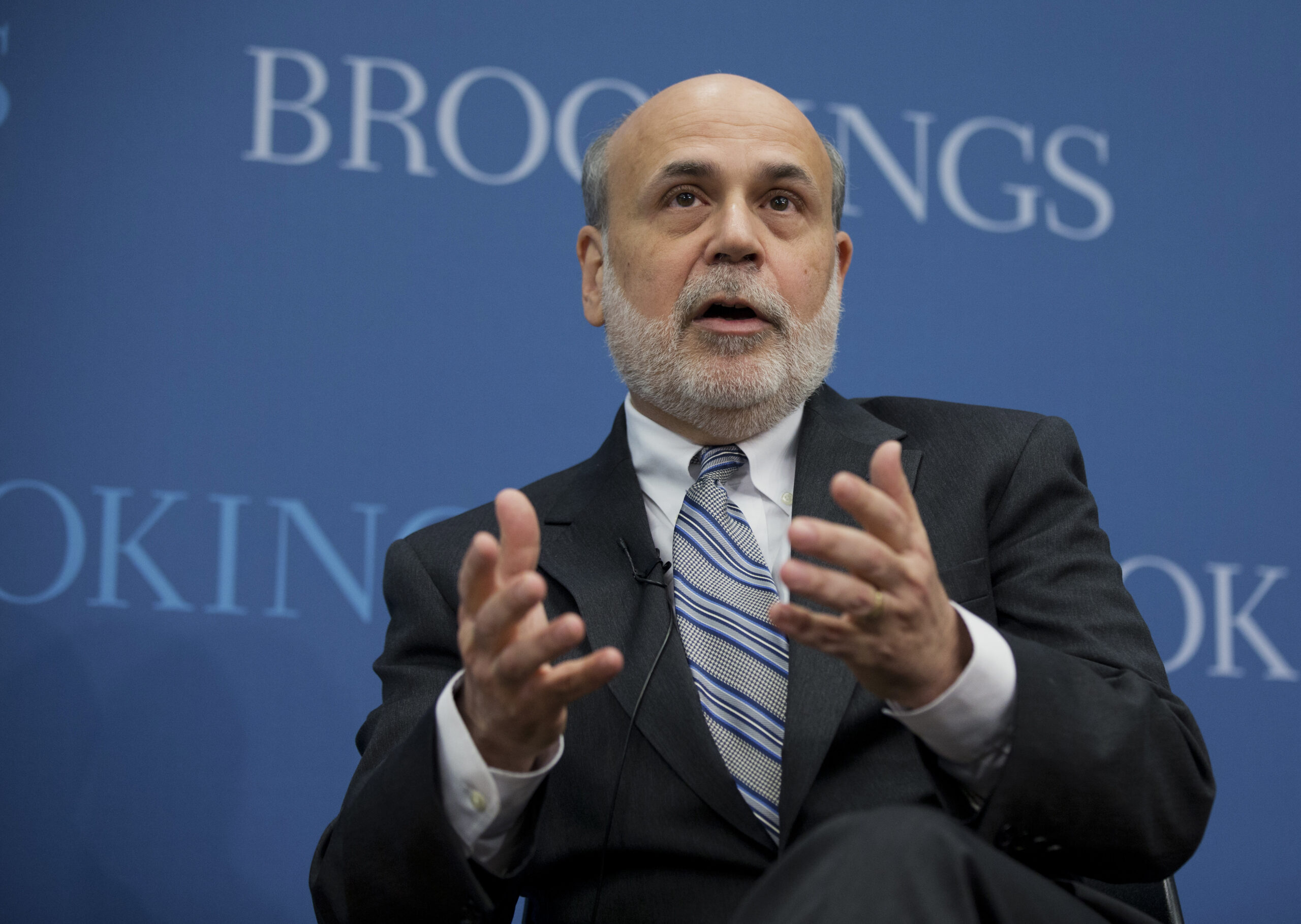
Former Federal Reserve Chairman Ben Bernanke on Monday said the central bank does not need more congressional oversight of monetary policy, but he floated the idea of emergency economic powers for the president to take pressure off the Fed.
“We hold ourselves accountable pretty well,” Bernanke said, speaking in the present tense although he left the top post at the Fed in January 2014. He appeared on a panel at the Brookings Institution, where he is now a scholar.
Recommended Stories



Many Republican lawmakers favor legislation introduced by Sen. Rand Paul, R-Ky., that would subject the Fed’s monetary policy decisions to policy audits by the Government Accountability Office. Current Fed Chairwoman Janet Yellen and other officials have criticized the audit idea in recent weeks on the grounds that it would politicize monetary policy decisions made by the independent central bank.
Bernanke, who was appointed by Republican George W. Bush, pushed back against Paul’s bill and other proposals to ramp up congressional oversight of the Fed. “I don’t think that Congress has failed to make the Fed accountable,” the former Princeton professor said.
“The Fed is all about explaining where the economy is and where they think the economy is going,” he said at one point.
He responded specifically to a separate bill favored by Republicans on the House Financial Services Committee, separate from Paul’s bill, that would require the Fed to state a rule for monetary policy based on unemployment and inflation and to explain itself when it deviated from that rule.
Under Bernanke’s leadership, the Fed published a long-term statement of goals and began publishing economic and interest rate projections each quarter. “I don’t think you can get much more precise than that,” Bernanke said.
The former Fed chief also addressed criticisms of the central bank issued by liberals who have objected to the 2008 bailouts of Wall Street banks.
Bernanke, who played a leading role during the financial crisis both in creating the Fed’s emergency lending programs and in prevailing on Congress to pass the TARP bailout legislation, warned against curbing regulators’ ability to respond to future financial crises. He is glad, he said, that the 2010 Dodd-Frank financial reform law limited the Fed’s responsibility for rescuing failing banks by instituting a process for the Federal Deposit Insurance Corporation to resolve insolvent banks. Nevertheless, he said, there are “trade-offs” involved in limiting the Fed’s flexibility in responding to crises.
Crises can be chaotic and difficult to address with rules established ahead of time, Bernanke warned. One possibility “worth thinking about,” Bernanke suggested, was to give the president some kind of power to declare economic emergencies to addressing failing companies and “not put it all on the Fed.”
