

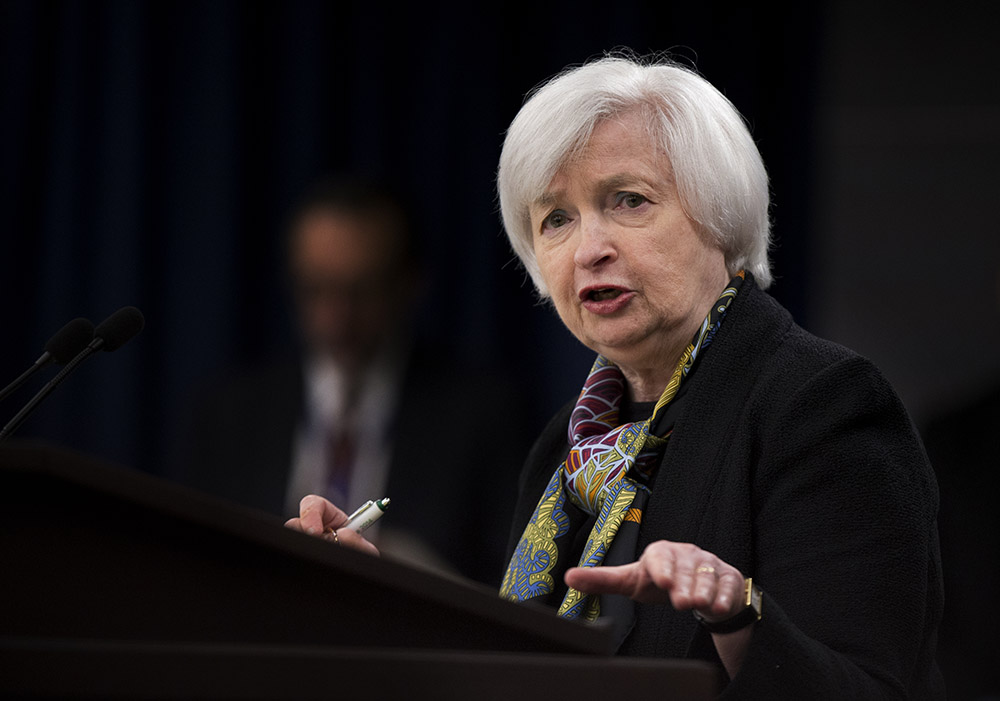
Federal Reserve Chairwoman Janet Yellen is increasingly relying on a new explanation for why the central bank has delayed raising interest rates even as the U.S. economy has neared, in her own estimation, maximum employment.
In recent public appearances, Yellen has emphasized that the Fed is likely to move its interest rate target with the “neutral rate” of interest, a subtle departure from talking only about economic growth or inflation, as is customary for the Fed.
Recommended Stories


In doing so, she has brought a relatively academic concept into the Fed’s management of the money supply, one that justifies the Fed’s current near-zero interest rate policies that have made some investors and lawmakers nervous.
The neutral real rate, as Yellen explained in a speech in New York City Monday, is the short-term interest rate, adjusted for inflation, that is neither expansionary nor contractionary if the economy were operating at potential — in other words, the rate that would balance the demand for money and the supply for money.
“It kind of lies at the heart of assessing the current stance of policy,” said Keith Hembre, chief economist at Nuveen Asset Management. The “neutral rate can only really be guessed at in real time, and I very much concur with her assessment that it is very low today,” he said.
The neutral rate is probably close to zero currently, Yellen said in her speech, meaning that the Fed’s current target of 0.25 percent to 0.5 percent is appropriate.
And Yellen offered an explanation of why the neutral rate might be so low, listing off factors that could depress the demand for money or credit, including weak growth in China and elsewhere overseas, the appreciation of the dollar, the fact that relatively few Americans are forming households and slow productivity growth.
The argument is, implicitly, a response to critics of the Fed’s policies who would argue that, since the unemployment rate is below 5 percent, interest rates also should be closer to some “normal” level — such as the 3 percent it was the last time unemployment was 4.9 percent, in early 2008.
One such congressional critic, Rep. Mick Mulvaney, R-S.C., challenged Yellen in a congressional hearing in February, asking why the Fed is not following the monetary policy it tended to employ during the “Great Moderation” before the financial crisis, predictably raising rates or lowering them depending on incoming inflation and output growth.
“Here we are in 2016,” Mulvaney noted, asking Yellen, “Are we in normal times?”
“The economy is in many ways close to normal,” Yellen responded, citing the unemployment rate. “But what’s not normal is that the so-called neutral level of the [short-term interest rate] … [it] is by no means normal.”
Although the idea of the “neutral” rate is not new, as it can be traced back at least to the Swedish economist Knut Wicksell in 1898, it is a relatively new point of emphasis in Yellen’s comments.
She highlighted it Tuesday in her speech in explaining that Fed members have lowered their expectations for raising interest rates this year even though they haven’t lowered their economic projections. In effect, they are expecting to counteract headwinds from China and elsewhere that have lowered the neutral rate.
Yellen also referred to low neutral rates in her press conferences in March and December, a new addition. In December, she also discussed the concept in a speech in Washington. Before then, however, she did not give the idea much attention as Fed chief.
It’s a way of thinking about monetary policy “that’s being discussed in Washington, in top academic institutions, and on Wall St., so it’s not that surprising that Yellen’s picked up on it, too,” said Boston College economist Peter Ireland in an email to the Examiner.
Yellen’s director of monetary affairs at the Fed’s Board of Governors, Thomas Laubach, was one of the first to write a detailed paper on the idea of the neutral interest rate, in 2003 with current San Francisco Fed President John Williams, Yellen’s successor at the regional bank.
And in February, Ireland noted, four prominent economists, including the chief economists of Goldman Sachs and Bank of America, published a high-profile paper finding that the neutral rate was hard to pin down but low, suggesting that the Fed should delay rate hikes for longer.
One clear implication of Yellen stressing the neutral rate is that it means that the specific rates targeted by the Fed in the months and years ahead will be less predictable and more tied to incoming economic data that in turn gives hints of the neutral rate.
“No one can be certain about the pace at which economic headwinds will fade,” Yellen warned in her speech. “More generally, the economy will inevitably be buffeted by shocks that cannot be foreseen.”
