

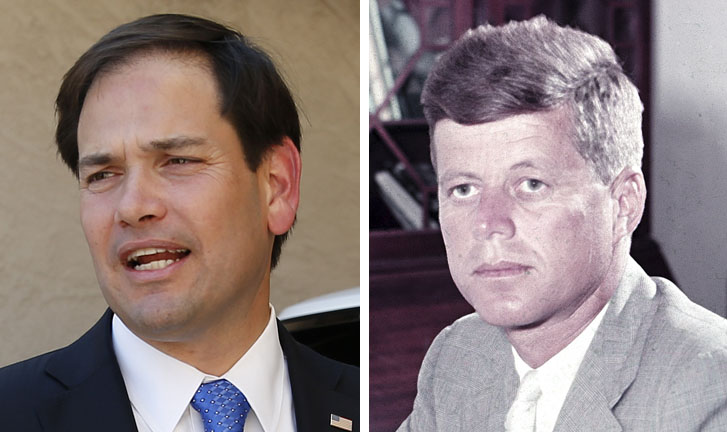
BOONE, Iowa — Marco Rubio is now making direct comparisons between himself and iconic President John F. Kennedy, a new wrinkle in the Florida senator’s sales pitch that he personally added to his stump speech just last week.
The comments weren’t ad-libbed. The 44-year-old Republican presidential candidate made the connection during two different campaign appearances in Central Iowa over the weekend. Rubio advisers confirmed that it was the first-term senator’s decision to remind voters that, once before, Americans handed the keys to the White House to a youthful senator in his early forties — Kennedy — who made a charismatic, patriotic appeal for a new generation of leadership.
Recommended Stories


“Sixty years ago this nation embraced a new frontier. This nation took up the challenge of a Democratic president, to ask not what your country can do for you but what you can do for your country,” Rubio told more than 1,500 Iowa Republicans who showed up in Boone for the latest cattle call of GOP 2016 contenders. “Unfortunately, for far too long, politicians in both parties have campaigned on the promise of what this country and this government is going to do for you. But I’m running for president on the promise of what we, together, can do for America.”
Kennedy was a 43-year-old first-term senator from Massachusetts in 1960, the year he won the presidency against Republican Vice President Richard Nixon.
Only time will tell, but the message could resonate, as Rubio seeks to counter questions about his relative youth and executive inexperience and distance himself from another (unhelpful) comparison to President Barack Obama, a 47-year-old first-term senator from Illinois when he was elected in 2008. It’s working for Rubio supporter Larry McKibben, a 68-year-old Republican former Iowa state senator and self-described “Baby Boomer” who attended a Rubio campaign event in Ames, Iowa.
“His message to me is about the generation of my kids and grandkids,” McKibben, an attorney from Marshalltown, Iowa, told the Washington Examiner. “That is the same message I grew up with, with John Kennedy. At the time that I got active in politics, that was the John Kennedy era. He was a young, vibrant, visionary person.”
“He was a great visionary leader and I sense this out of Marco Rubio and that is the difference — to me he’s the new John Kennedy,” McKibben added. “I think we hoped that Barack Obama would be that.”
From day one, Rubio’s campaign has revolved around the theme that American success in the 21st century requires a new generation of leadership not steeped in the past. In almost every speech, Rubio makes that point by lauding older generations of Americans for what they accomplished for the United States in the 20th century, but emphasizing that the only way the next 100 years will be as good, or “better” as he says, is if older Americans pass the baton to the younger set.
This appeal is symbolized by his simple and often-quoted declaration: “Yesterday is over.” The line has been interpreted as a not-so-subtle shot at both Hillary Clinton, the presumptive Democratic presidential nominee, and former Florida Gov. Jeb Bush, Rubio’s one-time political mentor.
Winning presidential campaigns almost always appeal to voters’ hopes for the future. However, the comparison to President Kennedy, assassinated in 1963 and rendered forever young in the American conscience, represents a new element in Rubio’s effort to parlay his biography as the son of Cuban immigrants, and political resume into victory in 2016.
Many Republicans, pointing to Obama, are arguing that their nominee should be a governor especially the current and former governors in the field. Rubio partisans say the senator can expand the electoral map for the GOP and grow the party, as his Iowa campaign chairman told National Journal’s Shane Goldmacher.
“He is a person who can reignite the Republican Party and unite it,” Whitver said to Goldmacher. “Like JFK, he can inspire the country.”
Disclosure: The author’s wife works as an adviser to Scott Walker.
