

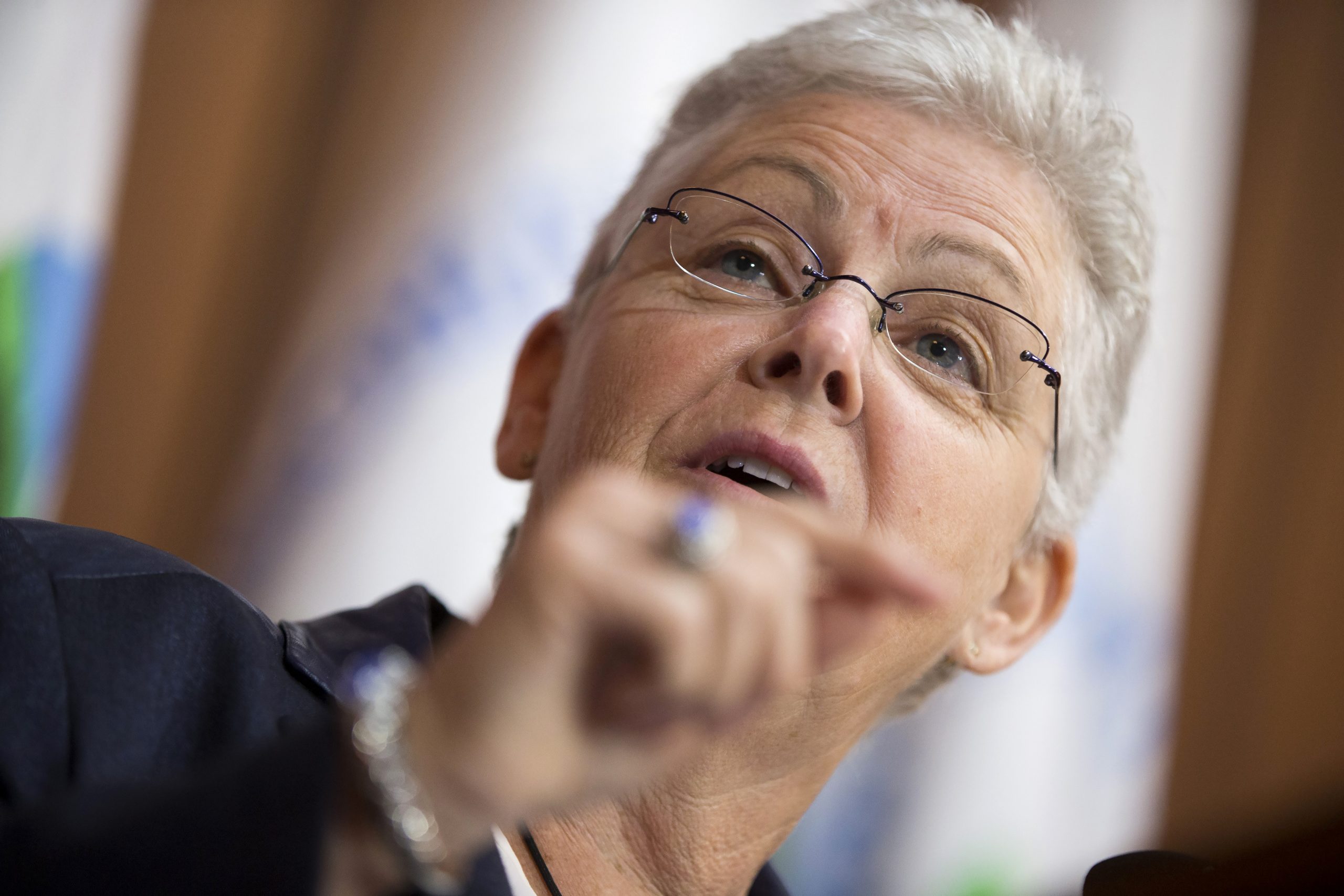
Environmental Protection Agency Administrator Gina McCarthy said her agency is following scientific advice on a proposed rule to tighten smog-forming ozone pollutions that falls in between what industry and environmentalists had hoped.
The dispute is over something seemingly arcane to the general public, but the EPA said reducing the amount of ozone in the atmosphere would amount to health benefits of up to $38 billion in 2025.
Recommended Stories


The EPA proposed lowering the amount allowed to 65-70 parts per billion. Environmental groups want 60, while industry officials want to leave the standard at 75 parts per billion.
“My sense was after looking at all of the science, my judgment was that the upper part of the range was where I would recommend our focus at this time,” McCarthy said during a media call, “because there was more uncertainty at that lower boundary.”
Scientists who advise the EPA had recommended the 65-70 parts per billion range. They also suggested that 60 parts per billion would deliver the most significant benefits to public health by reducing exposure to pollutants that contribute to heart and respiratory ailments. The EPA said it would take comments on both levels.
“I’m very mindful that my science advisers have indicated it should be on the table,” McCarthy said.
The ozone proposal is sure to set off political battles. Republicans will make it a focus when they take control of Congress in January, and industry groups plan to lobby to keep the current standard in place. Environmentalists hope to prod the White House to endorse 60 parts per billion, after President Obama yanked a 2011 EPA proposal that called for a 65-70 parts per billion range following pressure during his re-election campaign.
Industry groups quickly pushed back against the proposal, which EPA had to issue by December under court order. A final rule is due by October 2015.
Opponents say many states haven’t complied with the current standard, as some lack the ozone-monitoring technology it requires. While the EPA proposal doesn’t require states to install any additional monitoring technology, it asks 33 states to extend the period for which they track ozone levels.
They contend a more stringent proposal would raise costs by pushing counties into “nonattainment,” making it harder to obtain permits to expand or build new factories, refineries and other facilities. The American Chemistry Council, which represents large chemical-makers, said some of the $135 billion of investment it has lined up could be stranded if EPA goes with the lower level of the range it proposed.
“What that does is create greater uncertainty in terms of being able to obtain the permits,” Cal Dooley, the group’s chief executive, told the Washington Examiner. The former California Democratic congressman added that a more stringent rule also might increase costs by requiring manufacturers to buy more pollution offsets.
The EPA estimates far fewer counties would fall into nonattainment than opponents predict. If the level is set at 70 parts per billion, nine counties would fall into that category; for 65 parts per billion, it would be 68 counties.
That’s partly because air quality improvements since the EPA last proposed a stronger standard in 2011 will make it less costly to implement, McCarthy said. Those efforts include regulations to reduce sulfur content in gasoline, with power plant regulations designed to draw down emissions of mercury and other air toxics.
In 2011, the EPA suggested a 65 parts per billion standard would cost up to $44 billion to implement by 2020. Now the agency says it would cost up to $15 billion in 2025, excluding California, which was considered separately because geographical and topographical challenges will make its task of reducing smog harder.
“We’ve had a lot of improvement in air quality in general, so the amount of lift will be less,” McCarthy said, later adding, “Clearly our rules overlap with one another.”
