

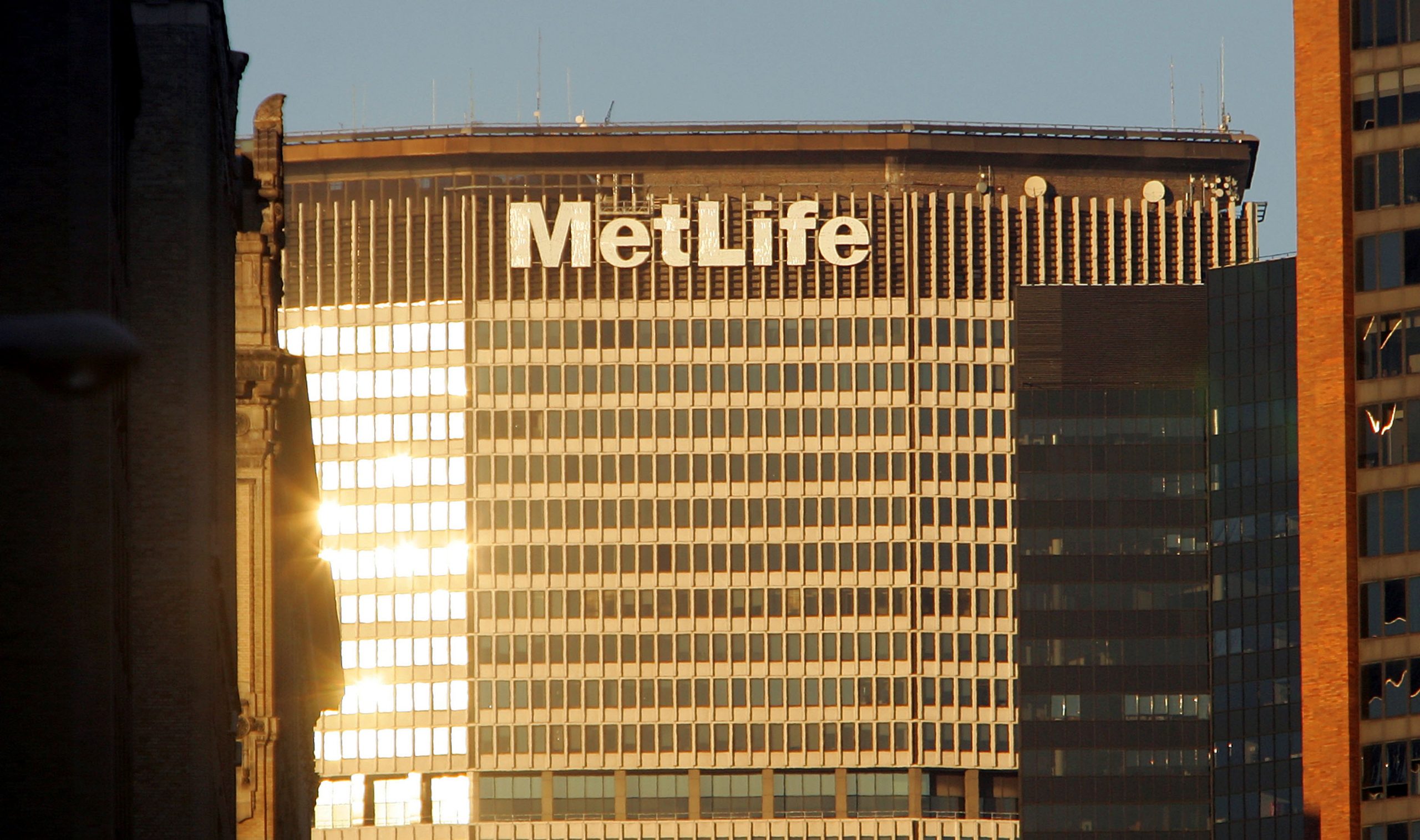
By trying to avoid stricter government regulation, life insurance company MetLife is posing a challenge to one of the major financial reforms passed in the wake of the 2008 financial crisis.
MetLife filed a lawsuit this week challenging federal financial regulators’ determination that it is a systemically important firm, one that poses enough risk to the financial system that it requires extra regulation and oversight as if it were a big bank.
Recommended Stories



That label was applied to MetLife by the Financial Stability Oversight Council, the super-group of regulators created by the Dodd-Frank financial reform law to find financial stability risks that might arise outside of regulators’ normal scope of investigation.
MetLife is not the first non-bank to be given the label. But it’s the first to fight back, a development that is being welcomed by critics of the council, who have said that it is too unaccountable and that it lacks transparency.
“I view the lawsuit as a positive step, and it will be good to bring this to some third party,” said Paul Kupiec, an expert at the conservative American Enterprise Institute in Washington who has raised concerns about the council’s efforts to impose bank-like regulations on non-bank companies.
After insurance company American International Group’s business in speculative derivatives trades failed and exacerbated the financial crisis in 2008, Congress created the council to identify similar threats in the future. Headed by the Treasury secretary and comprising all the chiefs of the major financial regulatory agencies, the council is viewed by advocates as an essential tool in making sure dangerous practices do not go overlooked.
But critics, especially congressional Republicans, have said that naming firms “systemically important” is equivalent to codifying them as “too big to fail.” They also have said that the council’s process lacks accountability and imposes costs on users.
MetLife has fought the designation every step of the way. After it was notified of the preliminary decision in September, it appealed to the council, claiming that it was not big enough to pose a risk and not engaged in the same kind of risky financial speculation that AIG was. The company has pressed its case in Washington-area media, including the Washington Examiner. And it has amplified that criticism in a lawsuit filed in the U.S. District Court for the District of Columbia.
In its suit, the insurance company says the “damages to MetLife alone likely includes hundreds of millions of dollars in costs per year as a result of new regulatory burdens.” The suit cited a study performed at the company’s request that found that imposing similar regulations on non-banks could cost consumers up to $8 billion a year.
MetLife faulted the council for the lack of transparency and cooperation during the process. The council hadn’t finalized the regulations for systemically-important insurers before saying it was one. When considering how MetLife would perform in a crisis, it contemplated unrealistic scenarios.
Going beyond that, however, the suit says the very structure of the council is unconstitutional. The council’s “structure violates fundamental separation of powers principles because it blends — in a single body of 10 voting and five non-voting members — all three powers of government,” according to the suit. That is, it writes its own rules, executes them, and adjudicates disputes with businesses. It also infringed on MetLife’s right to due process by notifying it that it was being considered to be labeled a systemically important firm late in the game.
Mark Calabria, the director of financial regulation studies at the libertarian Cato Institute, said that he did not expect the court to accept the constitutional challenge to the council itself, but that it could flag the council for the process problems.
“I’m glad that MetLife is suing because nothing else is going to push FSOC in the direction of clarifying what it’s doing,” Calabria said. “Nothing like a court decision hanging over your head to get regulators focused on an issue.”
Treasury Secretary Jack Lew has already moved to clarify the designation process, asking businesses and outside groups for recommendation last fall in the wake of MetLife pushing back against its designation.
But Congressional Republicans have sought to delay any further designations of businesses until the council clarifies its process, passing legislation in the House to do so.
The council’s process for identifying systemic firms is relevant as it considers regulating asset managers such as BlackRock and Fidelity.
“This should really slow that process down,” Kupiec said of the council’s deliberations regarding asset management.
Lew and other regulators have scheduled a council meeting for Jan. 21. Discussing the designation of non-bank companies is on the agenda.
