

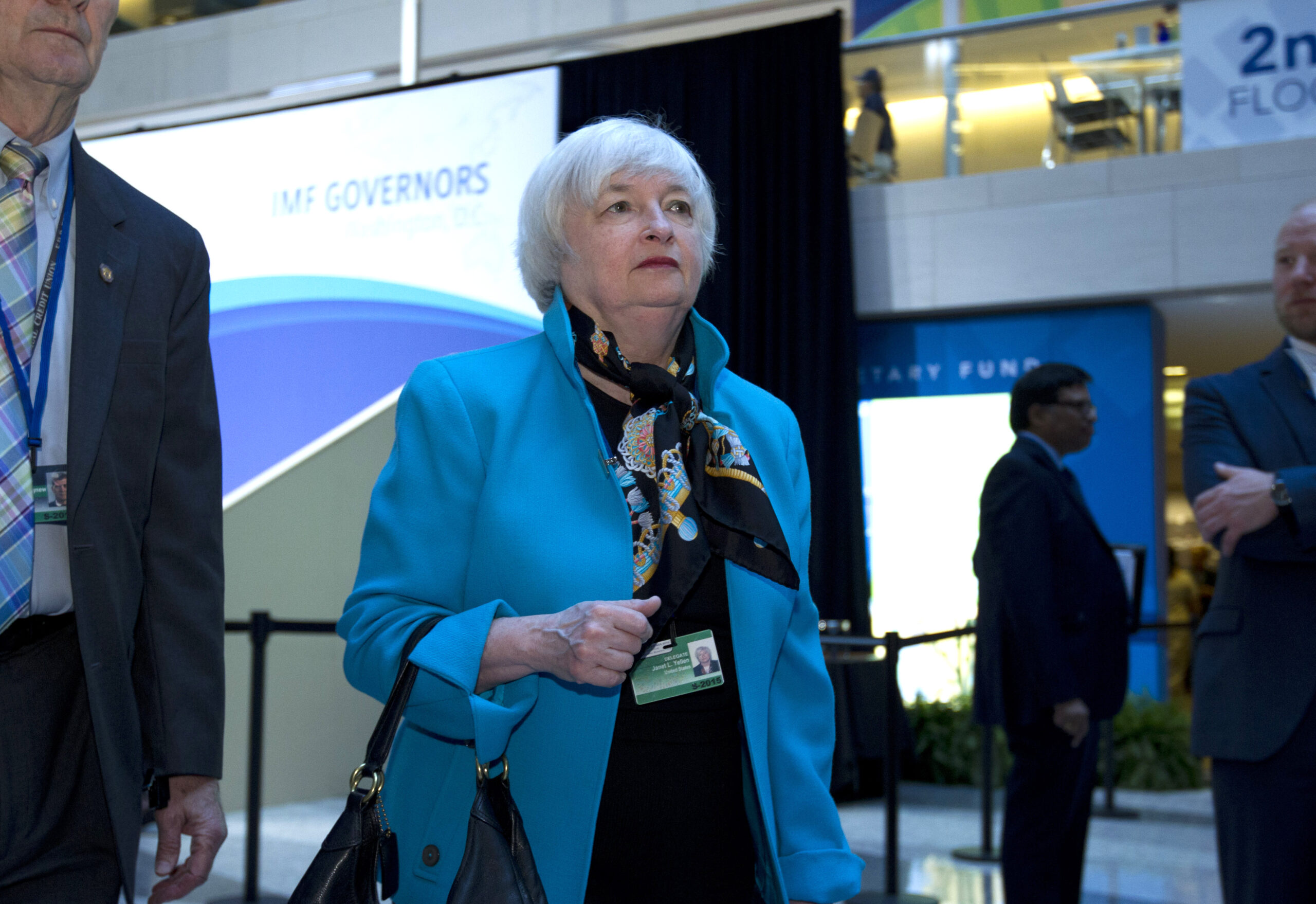
Chairwoman Janet Yellen and the other members of the Federal Reserve will face a tough question next week as they meet in Washington: Is the U.S. economic recovery faltering?
Throughout the winter and earlier spring, there were some signs of economic weakness: Weak consumer spending, slow new-home construction and declining manufacturing and mining. But those worrisome indicators could be brushed aside given the ongoing strong job growth.
Recommended Stories



But the jobs report for March revealed that much of that employment growth was illusory.
Only 126,000 jobs were created in the month, according to the preliminary results from the Bureau of Labor Statistics, the fewest in more than a year. Furthermore, the job gains for the previous two months were revised down significantly, revealing that job growth in early 2015 had slowed from the 260,000 average of 2014 that officials had touted as a breakthrough.
After the Fed’s March monetary policy committee meeting, which came before the jobs report release, the committee warned in its post-meeting statement that “economic growth has moderated somewhat.”
In their meetings Tuesday and Wednesday, Yellen and company will have to decide if that moderation could turn into an outright slowdown. If so, their plans to move away from crisis-era monetary policy, especially holding short-term interest rates near zero, might have to wait even longer.
“Despite the weak performance of the first quarter, I believe that the growth prospects for the U.S. economy over the remainder of 2015 will improve,” said Federal Reserve Bank of New York President William Dudley Monday, speaking just before the “blackout” period imposed on Fed members before the April meeting this week. “I expect that the first-quarter weakness will prove to be largely temporary.”
But Dudley, the vice chairman of the Fed’s monetary policy committee, also acknowledged that “there are some significant downside risks.”
If those risks materialized, they could threaten the central bank’s move toward tightening monetary policy, a decision that Yellen suggested in March could come as soon as June.
Bond market prices indicate that investors now do not expect the Fed to raise its interest rate target until December or even later.
The Fed’s stance is that it will raise rates when officials have seen “further improvement” in the jobs market and are “reasonably confident” that annual inflation will head up to the Fed’s 2 percent target.
Neither condition would be met if the economy is really slowing.
One possibility that Yellen and company will have to consider is that the underlying trend is still positive, but that there is flukiness in the first quarter disguising that reality.
Over the past five years, growth in the gross domestic product has averaged just 0.6 percent in the first quarter, much weaker than the 2.3 percent average for the full year.
“This pattern of a weak [first quarter] followed by above-trend economic activity thereafter is now becoming a familiar theme,” Deutsche Bank economists Joseph LaVorgna and Brett Ryan wrote in a research note Thursday.
First-quarter GDP growth is now expected to check in at just 0.1 percent, according to the latest forecast provided by the Federal Reserve Bank of Atlanta. The first estimate of first-quarter GDP will be released by the Department of Commerce as the second day of the Fed’s meeting begins on Wednesday.
It’s possible that, whether because of unusually severe winter weather or problems in the government’s statisticians’ corrections for seasonal fluctuations, the first-quarter slowdown will reverse itself in the months ahead.
But the other possibility is that the economic recovery really is not proceeding as planned.
“We’ll have to see if these factors are temporary or whether it is a broader reflection of what is happening globally,” Eric Rosengren, the president of the Federal Reserve Bank of Boston and a monetary policy voter, said in a lengthy interview with the Wall Street Journal on Monday.
Part of the problem, paradoxically, is that the United States’ relative strength to other countries has driven up the dollar, as the Fed is moving toward tightening while other central banks head toward easing.
“In particular, the roughly 15 percent appreciation of the exchange value of the dollar since mid-2014 is making U.S. exports more expensive and imports more competitive,” Dudley said.
Meanwhile, the collapse in the price of oil has stunted U.S. oil production, causing particular trouble for Texas, which has the nation’s second largest economy after California.
“It would be much easier for us to reach full employment and get our 2 percent inflation target if the rest of the world were growing more rapidly,” Rosengren said.
Yet Fed members could look beyond the problems facing manufacturers and oil drillers if they are confident that stronger job growth will resume later in the year, predicted Ian Shepherdson, chief economist of the research firm Pantheon Macroeconomics.
“What matters to the Fed is not individual sector pieces of data. We’ve learned this over and over again,” Shepherdson said Friday on Bloomberg Radio.
“We’ve got monetary policy set to prevent the end of the world, and we don’t have the end of the world, we have a labor market which is normalizing and the Fed needs to begin to respond to that.”
