

Maybe you have no interest in sitting in a bar with a bunch of strangers, drinking a beer, and bonding over a national sporting event. And that is fine. It is a free country. Sports bars aren’t for everyone.
But for millions of Americans, that feeling of community, of coming together to share something historic, not only adds to the enjoyment of sports but is a key component of what used to be our nationally shared culture.
Recommended Stories


Now, thanks to streaming, your local sports bar is in danger.
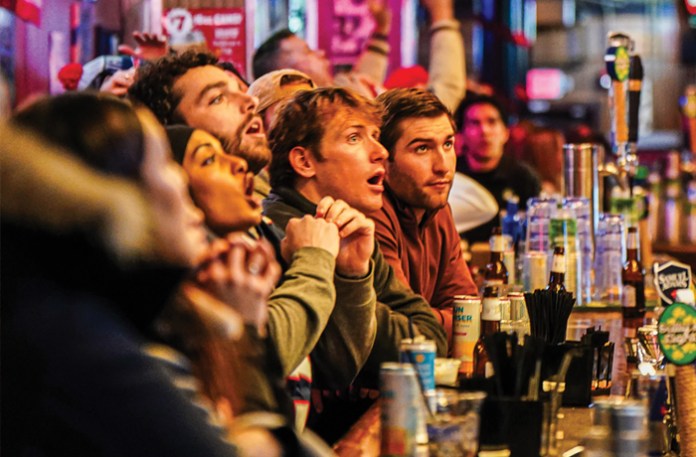
As recently as 2021, anyone with a basic cable subscription could pop on the TV and, with a few clicks, find whatever NFL game was being nationally broadcast that day. True, on Sundays when most of the league was playing, most games were only locally available unless you forked over a huge subscription for DirecTV, but the big national games, Thursday Night Football, Monday Night Football, Thanksgiving, and the playoffs were all available to everyone with basic cable.
All that is changing in the streaming era.
Starting in 2022, the NFL sold the rights to Thursday Night Football to Amazon on an exclusive basis. If you want to watch the same game the rest of the country is watching on Thursday nights, you now must have an Amazon Prime subscription. And it has only gotten worse since then. In 2025, you needed YouTube to watch the opening game between the Chiefs and Chargers in Brazil, Prime Video for the Black Friday game, Peacock for Saturday games in December, Netflix for the Christmas Day games, ESPN+ for a Monday Night game, and Prime Video again for the Wild Card playoff game between the Packers and Bears.
If you count a basic cable package as one subscription service (giving you access to ABC, CBS, FOX, and NBC broadcasts), you need an additional five subscriptions to watch all nationally broadcast NFL games last year, including Amazon Prime, ESPN+, Netflix, Peacock, and YouTube. That number rises to six if your cable package does not include the NFL Network, which aired six exclusive regular-season games played in Europe.
As complicated as finding all of these games is for casual fans, the logistics are even worse for sports bars. Even if your bartender knows how to get Netflix or YouTube TV to show up on a smart TV screen, that doesn’t mean he is legally allowed to show the game. Commercial establishments need a special license to put games on their televisions, and if they’re caught breaking the rule, they can be fined more than $20,000.
Yes, it is possible to track down all of the equipment and licenses to air every game. But it is time-consuming and expensive. For one sports bar in New York City, it costs about $100,000 a year. Not every local sports bar has the revenue to invest that kind of cash just to make sure they have the rights to every game.
It doesn’t have to be this way. There is no natural right to intellectual property. The NFL can sue bar owners for showing games without permission only because Congress artificially created that cause of action to begin with. What Congress created, Congress can take away. The only reason the NFL is even allowed to sell its broadcast rights as a single unit is that Congress gave it an antitrust exemption with the Sports Broadcasting Act of 1961. Congress has every right to revisit that special exception and attach conditions to it: no more exclusive streaming deals. All national games must be available through traditional cable channels. We don’t have to subscribe to six different streaming services just to watch football if we don’t want to. It is a policy choice.
CONN CARROLL: THE REAL REASON FERTILITY IS FALLING
Technology drives cultural change. On some level, we can’t stop that. But many of our technologies, and the manner in which they are monetized, are completely dependent on the policy choices we make.
If Congress won’t stop the streamification of sports, the neighborhood sports bar may soon need fewer barstools and more passwords.
