

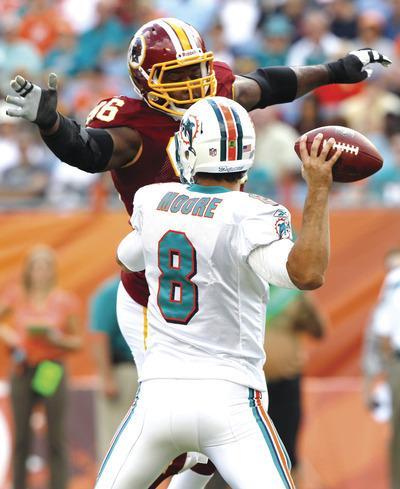
ASHBURN — Something different catches Barry Cofield’s attention each week. Against San Francisco, the guards blocked him in a way he hadn’t seen before or he would anticipate a block only to get hit by a tight end or by a different offensive lineman. Against Seattle, he kept waiting for the guards to attack him; instead, the center tried to handle him all game.
It’s a weekly education at nose tackle for Cofield. And it’s for that reason the coaches say he will be even better next season. He’s still getting used to making adjustments during the game.
Recommended Stories

“It’s not second nature to me yet,” he said.
| Notes |
| » Safety LaRon Landry did not practice because of a sore groin, which coach Mike Shanahan called a “setback.” Landry had missed the Dallas game two Sundays ago because of his sore Achilles. He hurt his groin during the win in Seattle. But the Redskins had hoped he would be fine enough to practice Wednesday. Others who did not practice: fullback Darrel Young (concussion), defensive end Stephen Bowen (knee) and linebacker London Fletcher (ankle). This is the third straight week Fletcher has missed practice time for his ankle. Linebacker Brian Orakpo (ankle), right tackle Jammal Brown (hip) and receiver Niles Paul (toe) were limited. |
|
» The Redskins signed cornerback Brandyn Thompson to the active roster for one good reason: Another team wanted to sign him as well. So the Redskins signed him instead. “We didn’t want to lose him,” Shanahan said. “He’s well aware that we like his skills, and we think he has a future here.” – John Keim |
On Sunday, for example, the Seahawks altered their blocking scheme and used the center more to block him. Three days later, Cofield, who admitted it wasn’t his best game, knows what he should have done to counter this strategy.
“I could have went more up the field and been more physical,” he said.
“They do so many different things to try and hit you,” coach Mike Shanahan said. “You’ve got to have your head on a swivel, and you’ve got to feel very confident in yourself.”
Getting upfield is something Cofield was used to doing as a defensive tackle for the New York Giants. Here, he’s still learning how to react to various tactics. And it’s difficult to do much about it until he watches the film. He’ll at least be familiar with Sunday’s opponent, Jets center Nick Mangold, whom he has faced since high school.
“It’s been balanced,” Cofield said.
Still, there’s likely something he will see for the first time. It has happened in most games. Against the Niners, for example, he anticipated the center blocking away and the guard blocking down on him. But they sent the guard to the linebackers, and he would get hit by a tight end blocking down. Until he saw this in the pictures on the sideline, he had no idea what was happening.
“There are times when I come to the sideline where I’m not sure what scheme I’m getting,” he said. “When I get a full offseason, the sky will be the limit for me. I’ll grow exponentially this offseason. … Next time I’ll see that San Francisco scheme, I’ll have that in the memory bank, and the next time I’ll face a zone team [like Seattle] that decides to switch it up, I’ll be ready.”
The coaches see his raw ability, evident in his quickness and penchant for recovering and getting back into a play even after he has been blocked a couple yards downfield.
“Barry can be one of the best nose tackles in the league,” Redskins defensive coordinator Jim Haslett said. “He’s a really smart player, and he analyzes the position. He’s strong and athletic, and he’s got a lot of savvy.”
Cofield said there’s a big difference between playing nose and defensive tackle in a 4-3 front, as he did with the Giants. Here, he has to see both guards and the center. In a 4-3, that wasn’t the case. And his gap responsibility changes at the last second more at nose than at tackle.
“Your responsibilities change the quickest,” he said. “You have to have quick feet. The [confusion] does cause you to freeze for a second, but I’m athletic enough to make up for a lost step with good speed and effort. The average nose tackle doesn’t play sideline to sideline, but I’m a guy you’ll see anywhere on the field.”
