

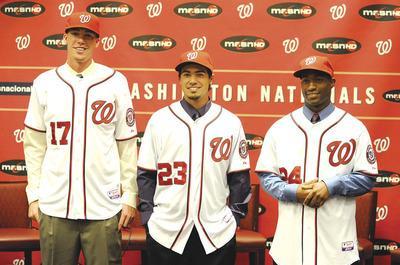
In six years, Rizzo took franchise from worst to first in Baseball America’s prospects ratings
For six years, Nationals general manager Mike Rizzo and his network of scouts and front-office executives worked to rebuild one of baseball’s worst farm systems.
Recommended Stories



He began as an assistant general manager with Washington, hired from the Arizona Diamondbacks in the summer of 2006. Six months later, Baseball America, the premier prospect evaluation publication, ranked the organization 30th in the majors — dead last. Only one Nats player, right-handed pitcher Collin Balester, even made Baseball America’s Top 100 prospect list that season.
Even after a solid 2007 draft, there was plenty more pain ahead, including a prospect scandal in the Dominican Republic that broke during spring training of 2009 and cost then-general manager Jim Bowden his job. Rizzo spent six months serving as the interim GM until he convinced both the Lerner family, which owns the team, and former team president Stan Kasten that he was capable of running the show.
For Harper, it’s the big unknown
– Brian McNally
| It is a question that will dominate spring training when the Nationals gather later this month in Viera, Fla. Where, exactly, will top prospect Bryce Harper begin the 2012 season? |
| The 19-year-old dominated at times in 2011, matching massive expectations during his first professional season with a rise to Double-A. He had a productive Arizona Fall League and at least will get the chance to compete for a job right away in 2012. Manager Davey Johnson has made no secret that he would love to start the year with Harper on board. But general manager Mike Rizzo and his staff likely will be more cautious. If Harper not only hits spring-training pitching well but shows the proper approach both at the plate and in the field — and if he’s clearly better than the competition — he could stick. But it’s no guarantee. |
| “We’re going to bring the best 25 north. If that includes Harper, it’s Harper,” Rizzo said last month. “When I believe Harper is ready to play in the big leagues, he’ll be in the big leagues. We’re not going to hinder his progress, but we’re not going to accelerate it to a point where I think it endangers his development and curtails his overall performance.” |
| Harper was named the No. 2 prospect in the sport this month by Baseball America, MLB.com and ESPN. If he doesn’t make the big league club out of spring training, he’s likely ticketed for Triple-A Syracuse, where he could fight his way back by midseason and take over a corner outfield spot. |
After years of neglect, Rizzo and his staff finally could enjoy the fruits of their labor in January when Baseball America ranked Washington’s farm system first overall thanks to a deep pool of prospects headed by 19-year-old phenom Bryce Harper; top college hitter Anthony Rendon, 21; and a bevy of promising young pitchers behind them. Rendon was part of a 2011 draft class that drew praise throughout the industry and is the culmination of an idea that bloomed in 2006 but wasn’t truly implemented until 2009.
“The plan three years ago was to attack the draft before the new [Collective Bargaining Agreement],” Rizzo said. “That was our focus. That was our vision. That was our strategy going into it. We did it. We attacked it for the last three years, and I don’t think you’ll see a draft class like last year’s because of the new CBA.”
That means teams are no longer allowed to spend more than Major League Baseball’s recommended slot bonuses. Gone are the days when top talent slipped because teams weren’t sure they could meet a given player’s demands. Washington took advantage of the system, losing games at the big league level in 2008 and 2009 and reaping the rewards with No. 1 overall picks Stephen Strasburg, an ace pitcher, and Harper, a phenom who was on the cover of Sports Illustrated at 16, among others.
Of course, part of building a top prospect pipeline is tearing it down. And even before Baseball America’s latest prospect handbook came out with its No. 1 ranking, several of Washington’s best young players already had been shipped off to Oakland in a blockbuster trade, Right-handers Brad Peacock and A.J. Cole were ranked third and fourth in the organization. Derek Norris, a promising catcher, was No. 9, while Tom Milone, a left-hander with some of the best control of any pitcher in the minors, was No. 12. All four were traded for right-hander Gio Gonzalez, who after two strong years in the American League immediately helps stabilize the Nats’ starting rotation.
The cost was nearly prohibitive, and the team will not be No. 1 when Baseball America reconvenes next month to rerank the 30 big league clubs. It’s possible that Cole, one of the sport’s 30 best prospects according to ESPN analyst Keith Law, could become a top-of-the-rotation starter. But as talented as he is, the odds are against Cole — or any prospect — reaching that level. And so Rizzo was eventually OK with watching his handiwork blown apart if it meant grabbing a player who can help the Nats this season and beyond. Now it’s time to rebuild again with the 2011 draft class as the foundation.
“We have to know that we’re getting better than we’re giving. That’s the secret of this thing,” Rizzo said. “These guys are tough to move. You have relationships with these guys. It’s like four of your children going to Oakland … but you can’t get caught up in that. You’ve got to evaluate them and evaluate them without rose-colored glasses. You better know your organization better than anybody else knows it.”
